 +91-808 8919 888

 AI & Solutions
  January 10, 2026
  4 mins read






In an age where customer expectations are higher than ever, traditional manual customer service models are struggling to keep pace. Customers demand instant resolutions, 24/7 availability, and personalized interactions. The answer lies in embracing customer service automation.
Customer service automation involves leveraging technology, primarily Artificial Intelligence (AI) and Machine Learning (ML), to handle routine inquiries, streamline workflows, and empower agents to focus on complex, high-value interactions. It’s not about replacing humans, but about augmenting their capabilities and creating a more efficient, consistent, and satisfying experience for everyone.
This comprehensive guide will walk you through the core components, benefits, and strategic implementation of automated customer service, helping you transform your support operations.
What is Customer Service Automation?
At its heart, customer service automation is the process of using software and AI-driven tools to perform tasks traditionally handled by human agents. This includes everything from answering FAQs and routing calls to processing refunds and personalizing customer outreach.
The goal is to provide faster, more accurate, and more scalable support while simultaneously reducing operational costs and improving overall customer satisfaction.
Key Components of Automated Customer Service
Effective customer service automation relies on a suite of integrated technologies:
- Chatbots & Virtual Assistants: AI-powered conversational interfaces that can understand and respond to customer queries via text or voice.
- Intelligent Virtual Agents (IVAs): More advanced than traditional IVRs, IVAs use natural language processing (NLP) to understand intent and offer self-service options or intelligent routing.
- Knowledge Bases & FAQs: Centralized repositories of information that can be accessed by both customers (for self-service) and agents (for quick reference).
- Workflow Automation: Tools that automate repetitive back-office tasks, such as ticket creation, data entry, and email responses.
- Sentiment Analysis: AI that analyzes the emotional tone of interactions to prioritize urgent cases or provide real-time agent assistance.
- Omnichannel Integration: Seamless flow of information and interactions across various channels (web, mobile, social, email, phone) to provide a unified customer journey.
The Benefits of Automated Customer Service
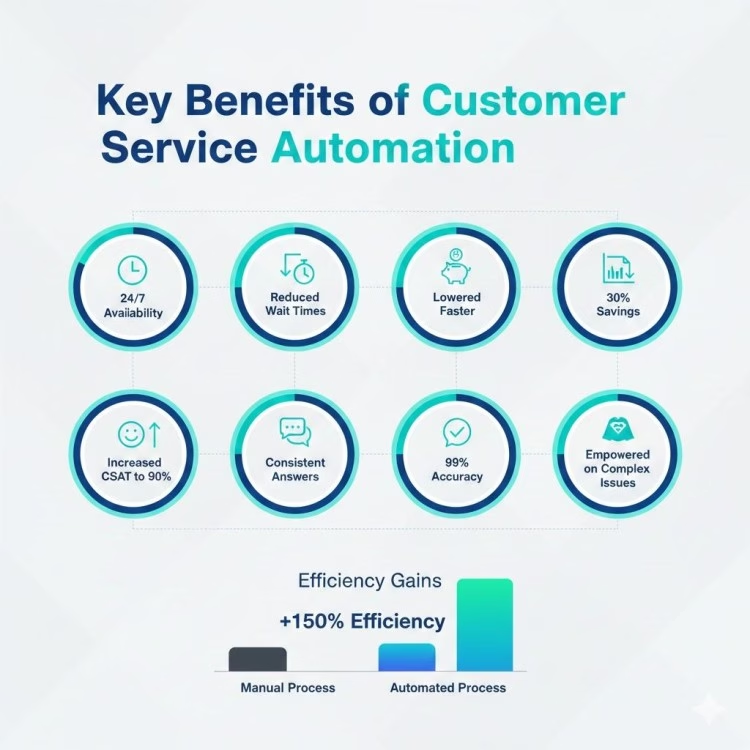
Implementing customer service automation delivers a multitude of advantages that positively impact both your customers and your bottom line.
Key Benefits of Customer Service Automation:
Strategic Implementation: Automating the Right Way
Effective automated customer service isn’t about automating everything; it’s about automating the right tasks to optimize the customer journey while preserving the human touch for complex issues.
Phase 1: Automate Tier 0 and Tier 1 Queries (Self-Service)
This phase focuses on deflection, addressing high-volume, low-complexity issues without human intervention.
- Intelligent Routing: Use AI-driven IVAs or chatbots to analyze customer intent (e.g., “I need to check my balance”) and automatically route them to the best resolution point, whether that’s a self-service option, a specific bot workflow, or the most qualified human agent.
- Knowledge Base Deployment: Ensure your internal and external knowledge bases are easily accessible and up-to-date. Chatbots should prioritize searching these bases to provide instant, accurate answers to common questions (FAQs, password resets, hours of operation).
- Proactive Alerts: Automate proactive messages for common issues like system outages, delivery delays, or pending payments. This drastically cuts down on inbound inquiry volume before it even starts.
Phase 2: Empowering the Agent (Assisted Service)
Even when a human agent is involved, customer service automation should be working in the background to enhance their capabilities.
- Agent Assist Tools: Real-time AI tools listen to the conversation (voice or chat) and automatically pop up relevant scripts, documents, or data from the CRM. This reduces Average Handle Time (AHT) because the agent spends less time searching and more time solving.
- Analogy: Think of it as giving your agent a powerful co-pilot that has instant access to every piece of customer history and company knowledge.
- Automated Summarization: After an interaction, the AI automatically summarizes the call, identifies the resolution, and updates the CRM, eliminating the need for tedious manual post-call work (wrap-up time). This directly increases agent productivity.
Phase 3: Post-Interaction Automation (Feedback and Follow-Up)
Automation ensures you capture critical data and follow up effectively, closing the loop on the customer experience.
- Automated Feedback Loops: Instantly trigger CSAT or NPS surveys after an interaction based on criteria like call reason or sentiment score (using the principles of sentiment analysis).
- Automated Case Routing: If a customer gives a low score or requests a callback, the system automatically creates a high-priority ticket and routes it to a specific retention or supervisory team for immediate follow-up.
- Analytics and Reporting: Automated customer service platforms generate reports on agent performance, chatbot success rates, and root causes of customer frustration, providing continuous optimization insights without manual data collection.
Measuring Success: KPIs for Automated Support
To prove the ROI of customer service automation, you must track metrics that reflect both efficiency and customer satisfaction.
| KPI (Key Performance Indicator) | Impact of Automation | Goal Improvement |
| Deflection Rate | Percentage of contacts resolved by a bot/self-service without reaching a human. | Increase (e.g., Target 60%+) |
| Average Handle Time (AHT) | AI assists and self-service reduce resolution time for both human and bot interactions. | Decrease |
| First Contact Resolution (FCR) | Intelligent routing and instant knowledge access increase the chance of resolving the issue on the first try. | Increase |
| CSAT & NPS | Faster service, 24/7 availability, and reduced frustration lead to higher satisfaction scores. | Increase |
| Operational Cost Per Contact | Automating repetitive tasks dramatically reduces the unit cost of service delivery. | Decrease |
Impact of Automation on Key Metrics
The Future of Support: AI Human Harmony
The most successful customer service automation strategies treat AI not as a replacement, but as the foundation of a sophisticated, high-performing service ecosystem. By allowing AI to handle the volume and consistency, you empower your human team to deliver the empathy and expertise that builds lasting customer loyalty. This is the AI Human Harmony model, ensuring that every customer interaction—whether automated or assisted—is efficient, effective, and meaningful.
Ready to implement a powerful automated customer service solution that scales your operations, boosts your CSAT, and gives your agents a superpower?
Partner with Exotel to build your AI-powered contact center and unlock true business growth.
Book a Free Consultation with an Exotel Automation Expert Today

Certified by HubSpot and Google, I’m a B2B SaaS marketer with 12+ years of experience building scalable marketing engines across content, demand generation, product marketing, and GTM strategy. I’ve helped grow CRM and CX platforms by driving organic growth, improving SQL conversions, and accelerating pipeline across global markets including UAE, KSA, APAC, Africa, and the USA. I believe in human-first messaging, revenue-linked strategy, and building systems that scale.


