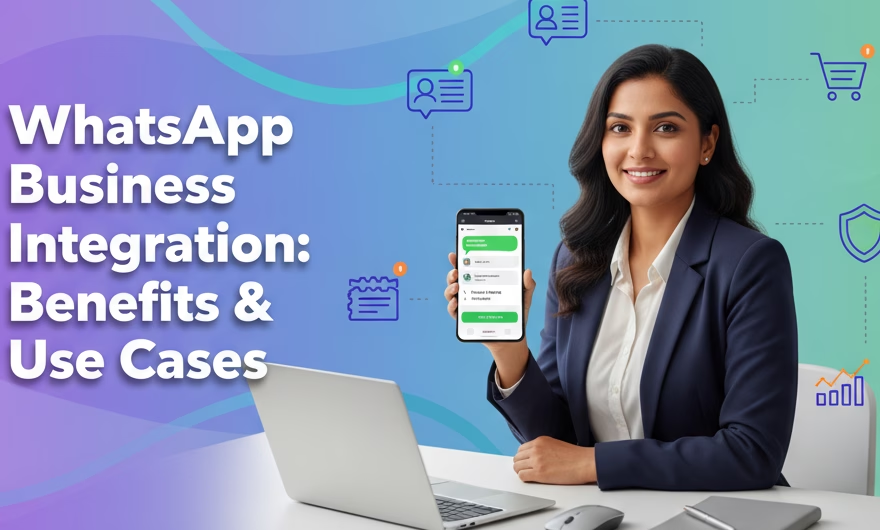




WhatsApp Business Integration—often referred to as the WhatsApp Business Platform (on-premise API and Cloud API)—is an advanced way for companies to connect their existing systems (CRM, helpdesk, payment gateways, order management, and more) with WhatsApp via the WhatsApp API. Unlike the standalone WhatsApp Business app that suits small teams, the platform is designed to help medium and large businesses automate workflows, route conversations to the right teams, and deliver consistent, secure customer experiences at scale.
By integrating WhatsApp with your core tools, you eliminate repetitive manual work and gain developer-friendly building blocks to create end-to-end customer journeys.
As of 2025, WhatsApp continues to support a 24-hour customer care window for free-form replies—outside that window, businesses initiate conversations using approved message templates. This keeps outreach relevant, timely, and compliant while enabling faster actions and solutions for customers.
1. Business Profile
A complete, trusted business profile helps customers recognize and trust your brand from the first touch. It personalizes your presence on WhatsApp and communicates essential details right inside the chat interface.
- Essential information: Add your business name, logo, description, phone number, address or location pin, category, business hours, email, and website/links. This makes it easy for customers to confirm they’re talking to the right brand and understand what you offer.
- Brand trust with verification: Eligible brands can apply for “Official Business Account” status (green badge). While not mandatory, it signals authenticity and can improve response rates.
- Consistency across touchpoints: When integrated, your WhatsApp identity mirrors your brand data in your CRM and website, keeping information consistent and up to date.
- Faster decision-making: Customers can quickly assess if you provide the services they need—reducing confusion and improving self-service.
For businesses managing multiple regions or lines of business, integration centralizes profile management and ensures changes propagate reliably across teams and systems.
2. Quick Replies
Quick Replies reduce repetitive typing and standardize answers to frequently asked questions. With WhatsApp Business Integration, you can orchestrate these responses across agents, bots, and workflows.
- Reusable, brand-safe responses: Set predefined replies for greetings, operating hours, delivery updates, booking confirmations, and more. Create variants for different scenarios and languages to maintain tone and clarity.
- Smart automation: Route common queries to chatbots or knowledge-base snippets, and seamlessly hand off to live agents for complex cases—without losing context.
- Compliance-aware messaging: As of 2025, WhatsApp’s 24-hour window policy applies: agents can send free-form messages within the window, while template messages handle proactive or out-of-window updates. Quick Replies should align with this policy.
- Security and privacy: WhatsApp secures messages in transit and at rest on its platform, while businesses should secure their integrated systems and follow applicable data protection laws.
Well-designed Quick Replies improve speed-to-answer, ensure accuracy, and deliver a consistent customer experience across teams and time zones.
3. Third-party Integrations
Integration is where WhatsApp becomes a true business channel. By connecting WhatsApp with your existing stack, you turn conversations into outcomes.
- CRM and customer data platforms: Pull customer history, preferences, and recent orders into the chat, and push conversation outcomes back to the profile. This unlocks personalized service at scale.
- Helpdesk and ticketing: Automatically create, update, and resolve tickets from WhatsApp threads. Use tags, priorities, and SLAs to manage queues and improve resolution times in your contact center.
- Ecommerce and order management: Share order status, delivery updates, and return instructions. Accept reorders or changes with structured prompts and confirmation messages.
- Payments and verification: Send secure payment links, trigger one-time passwords, and confirm transactions using approved templates (e.g., authentication or utility categories as of 2025).
- Analytics and governance: Centralize opt-ins, preferences, and consent records. Track delivery, reads, responses, and agent productivity inside your analytics stack.
Whether you use Meta’s Cloud API or a managed deployment, integrations via webhooks and APIs let you orchestrate journeys end to end—reducing swivel-chair work and minimizing errors.
4. Personalize Experience
Recognition and relevance drive loyalty. WhatsApp Business Integration lets you personalize every interaction with context from your systems.
- Dynamic templates: Use variables to greet customers by name, reference recent activity, and tailor recommendations. Keep content concise and value-led to respect chat norms.
- Interactive messages: Guide customers with quick-reply buttons and lists to help them choose options, confirm actions, or navigate support flows without typing.
- Segmentation and timing: Trigger messages based on lifecycle events (onboarding, renewals, abandoned carts, service reminders) and send at contextually relevant moments.
- Preference and consent management: Honor opt-ins, language preferences, and quiet hours. Make opt-out simple and immediate to maintain trust and deliverability.
With data unified across your CRM, helpdesk, and commerce tools, personalization feels natural—not intrusive—driving higher satisfaction and conversion while reducing back-and-forth.
5. Enhance Campaigning
WhatsApp can be a high-performing channel for lifecycle, service, and marketing messages when used responsibly and with clear value to the customer.
- Template-based outreach: As of 2025, proactive campaigns use approved templates aligned to WhatsApp’s categories (e.g., marketing, utility, authentication, service). Keep copy helpful, transaction-focused, and compliant with opt-in policies.
- Message performance insights: Track sends, deliveries, reads, responses, and link clicks. Use these insights to refine copy, timing, and audience segments.
- A/B testing and iteration: Experiment with call-to-action placement, interactive buttons, and message sequencing. Iterate based on real engagement signals.
- Conversation-based pricing awareness: WhatsApp applies conversation-based pricing by category and region (as of 2025). Plan campaigns to maximize ROI by combining service updates with relevant offers and clear next steps.
- Acquisition with Click-to-WhatsApp: Run ads that open a WhatsApp chat from social platforms. Sync campaign source parameters with your CRM to measure downstream impact on sales and service.
- Frequency and fatigue management: Cap the number of proactive messages, avoid redundancy with email/SMS, and pause outreach when a service issue is active to protect customer experience.
When you combine responsible targeting with meaningful content, WhatsApp campaigns earn attention—not mutes—while providing measurable business impact.
Wrapping Up:
WhatsApp Business Integration is most valuable for medium to large organizations that need reliability, security, and scale. By connecting WhatsApp to your CRM, helpdesk, order systems, and analytics, you move beyond chat into orchestrated customer journeys—faster resolution, richer personalization, and stronger campaign performance. As of 2025, aligning with WhatsApp’s 24-hour window, template categories, and opt-in requirements ensures compliant, customer-friendly experiences.
To get the most from WhatsApp, pair the platform with integration capabilities in your existing stack or with a customer engagement solution like Ameyo by Exotel that unifies channels, routing, reporting, and governance. The result is a modern service and marketing engine that meets customers where they already are and turns conversations into outcomes.