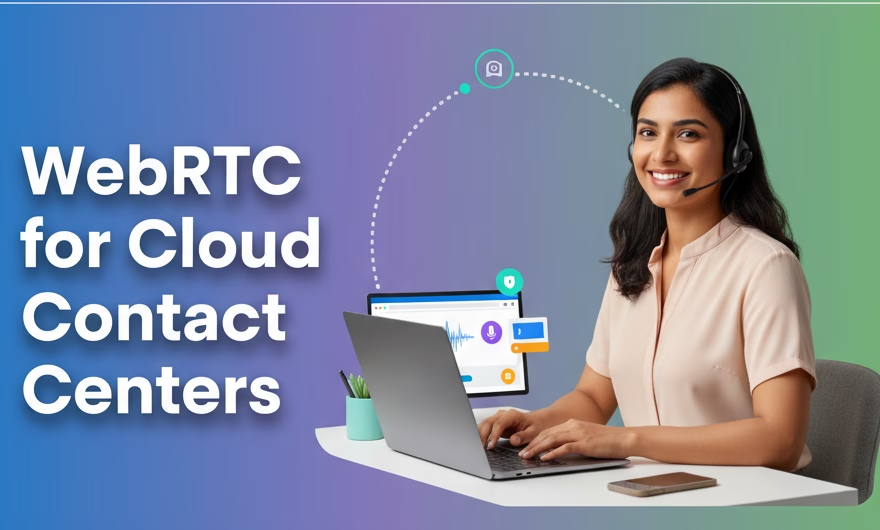




WebRTC is a real-time, disruptive communication technology that integrates channels, routes calls to web browsers, and is cost-effective. It is one of the best digital disruptive technologies available, offering seamless connectivity by integrating the advantages of siloed communication channels businesses use at various touchpoints. By enabling secure, plugin-free voice, video, and data directly in the browser, WebRTC removes friction for both customers and agents while lowering total cost of ownership for the contact center.
“WebRTC removes friction for both customers and agents while lowering total cost of ownership for the contact center.”
Over the last decade, and especially since WebRTC 1.0 became a W3C Recommendation in 2021, WebRTC has provided an efficient solution that easily transcends technological and communication barriers faced by businesses and their customers during interactions. As of 2025, all major modern browsers natively support WebRTC, making it a mature, standards-based foundation for cloud contact center experiences on desktop and mobile without additional software or extensions.
Leading enterprise communications providers and cloud platforms have invested significantly in developing and adopting WebRTC, recognizing its potential to radically transform customer and agent communication. This widespread industry backing has matured the surrounding ecosystem—gateways, SDKs, analytics, and quality tooling—making it easier than ever for contact centers to deploy reliable, secure browser-based calling at scale.
Amazon’s “Mayday” feature on the Kindle Fire HDX popularized the idea of live, in-device assistance that lets users connect with support experts for instant help. That concept—embedded real-time support with context from the customer’s screen or session—is now practical on the web via WebRTC and is increasingly used to power personalized assistance within cloud contact center solutions.
Why should you consider WebRTC for your contact center?
WebRTC enables real-time communication that is fully customer-centric. In a contact center context, the IVR or routing engine can direct a call or callback request straight to an agent’s web browser instead of a physical phone or traditional CTI software. The result is rapid setup and connection times, reduced dependency on desk hardware, and simplified agent onboarding—delivering experiences that impress customers and prospects from the very first interaction.
Beyond basic voice, WebRTC supports richer, context-aware interactions. Customers can “click-to-call” from a website or app and carry session context (cart contents, page metadata, CRM identifiers) into the conversation so agents are instantly informed. Screen sharing and co-browsing are possible with appropriate consent, letting agents guide users through forms or checkout flows. For remote and hybrid teams, a browser-based softphone means agents can securely work from anywhere, with traffic encrypted in transit and quality monitored in real time.
The advantages of WebRTC in contact centers include:
- Seamless integration of communication channels for unified interactions. Embed voice and video directly in web and mobile experiences to bridge digital and voice channels, while passing context from chat, email, or self-service journeys to the live conversation.
- Quick and efficient call routing directly through web browsers. WebRTC minimizes call setup latency and removes the need for plugins or desk phones, enabling instant connections from both customer and agent endpoints.
- Enhanced user experience leading to higher customer retention. One-click, in-session help reduces effort, shortens time-to-resolution, and increases customer satisfaction and loyalty.
- Boosted sales through improved customer engagement. Guided assistance at critical moments—such as checkout or onboarding—helps reduce abandonment and increases conversion.
- Cost-effectiveness by reducing reliance on traditional telephony infrastructure. Browser-based calling reduces hardware costs, softphone licensing, and PSTN minutes by shifting more interactions to IP, while preserving SIP/PSTN connectivity when needed.
- Secure by default with enterprise-grade encryption. Media streams use DTLS-SRTP in transit, and WebRTC runs in secure browser contexts—helping organizations meet stringent security expectations while enabling compliance controls like server-side recording.
- Operational flexibility and scalability. As of 2025, mature WebRTC infrastructure (ICE/STUN/TURN) handles NAT traversal and network variability, while adaptive codecs such as Opus maintain call quality even under poor bandwidth conditions.
Many contact center management teams have already recognized the importance of adopting WebRTC alongside cloud contact center solutions to achieve these benefits. As of 2025, it’s common to see agent desktops that run entirely in the browser, with WebRTC “softphones” replacing physical handsets, accelerating deployment, and simplifying IT support.
How WebRTC strengthens cloud contact center operations
WebRTC fits naturally into cloud-first architectures and modernizes core workflows without disrupting established routing logic or reporting. A few practical ways it strengthens operations include:
- Simplified agent setup and remote readiness. Provision agents instantly with a URL and a headset—no desk phone shipping, VPN clients, or complex installs. This supports seasonal ramp-ups, BPO onboarding, and distributed teams.
- Intelligent, contextual routing. Pair click-to-call or web callbacks with IVR and skills-based routing. Carry session data into the agent’s browser to reduce handle time and repeats.
- Consistent quality management. Use the WebRTC stats API to monitor jitter, packet loss, and bitrate in real time. Trigger alerts, coach agents, and proactively remediate issues before they affect customer experience.
- Interoperability with existing voice systems. WebRTC gateways bridge to SIP trunks and PSTN when needed, letting you migrate gradually and protect current investments while moving more traffic to the web.
- Better audio fidelity at lower bandwidths. The Opus codec provides high-quality, adaptive audio performance, improving intelligibility and reducing fatigue for both customers and agents.
Security, reliability, and compliance—built in
Enterprise contact centers require rigorous security and reliability. WebRTC is designed with these needs in mind. Media is encrypted in transit (DTLS-SRTP), and sessions run in secure browser contexts (HTTPS). Identity, authentication, and authorization are handled by your existing web app and contact center platform policies, ensuring that only validated users and agents connect.
Reliability is achieved through adaptive bitrate control, jitter buffers, and fallback mechanisms such as TURN relay when direct paths aren’t possible. As of 2025, vendors routinely combine WebRTC telemetry with network policies to maintain call quality across variable home and mobile connections. For compliance, server-side recording, audit trails, consent prompts for screen sharing, and data retention controls can be configured to meet regulatory requirements in regulated industries.
A pragmatic path to adoption
Getting started with WebRTC does not require a wholesale transformation. Most organizations begin by enabling browser-based agent calling within their cloud contact center, then add customer-facing click-to-call on high-intent pages. From there, they layer co-browsing for complex workflows and move more use cases off the PSTN as confidence grows.
Key success factors include:
- Ensuring headsets and endpoints are standardized for agents to reduce acoustic echo and improve clarity.
- Instrumenting quality metrics and setting thresholds for proactive troubleshooting.
- Planning for network edge cases with TURN capacity and clear escalation paths.
- Defining security and consent flows for features like screen share and call recording.
- Phasing migration to protect existing SIP/PSTN investments while realizing IP cost savings.
With Ameyo by Exotel’s cloud-first approach, teams can adopt WebRTC incrementally, preserve their existing routing and reporting, and elevate both customer experience and agent productivity.
The bottom line
WebRTC represents a new technological force in cloud contact center solutions, promising to enhance communication capabilities, reduce barriers, and improve customer experience on a large scale. As of 2025, it is standardized, widely supported across browsers, and proven at enterprise scale. For customers, that means instant, in-context help without downloads. For contact centers, it means faster deployments, lower costs, improved security, and higher-quality interactions—delivered through a simple, browser-based experience. Organizations that embrace WebRTC within their cloud contact center will be better positioned to meet rising expectations for fast, personalized, and effortless service.