



Types of Chatbot and What to Pick For Your Business
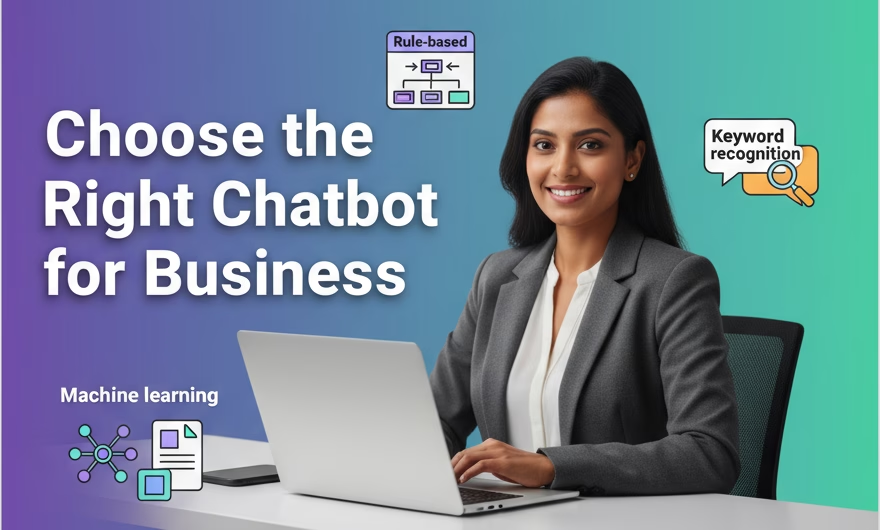
A chatbot is an AI-based program that simulates human conversations to help customers complete tasks or find information with minimal friction. They act as digital assistants across websites, apps, social channels, and contact centers, guiding users through common scenarios like FAQs, order tracking, appointment bookings, and basic troubleshooting. As of 2025, most business chat experiences fall into a few core types that differ in how they understand language, how they’re built, and the level of control and personalization they offer.
1. Rule-based Chatbots
If you can predict what type of questions your customers may ask, a rule-based chatbot is often the right fit. These bots follow predefined flows and if/then logic to create deterministic, guided conversations. They can use buttons, quick replies, and decision trees to make it easy for customers to pick options and reach the right outcome quickly.
In rule-based chatbots, businesses define the language conditions of the bot—such as recognized phrases, intent triggers, and acceptable variations (including order of words and common synonyms). When a user’s query matches a defined condition, the bot returns the mapped response immediately. This makes rule-based bots reliable for high-volume, repetitive queries where precision and compliance are important.
When they work best
- Predictable, high-frequency questions (e.g., business hours, return policies, delivery status)
- Processes that are form-like or guided (e.g., raising a service request, booking/rescheduling, checking balances)
- Regulated scenarios requiring strict, auditable responses
- Multilingual support when scripts can be authored and reviewed in each language
Advantages
- Consistent outcomes with minimal risk of off-script responses
- Fast time-to-value for well-known FAQs and workflows
- Simple to govern, test, and approve across legal/compliance teams
- Easy to measure and optimize with clear drop-off points in the flow
Limitations
- Brittle when facing unanticipated or long-tail queries
- Requires ongoing maintenance to keep scripts and conditions current
- May struggle with typos, colloquialisms, or multi-intent messages without added NLP
Design tips
- Map the top 10–20 intents that drive most volume and build clear, short paths
- Add disambiguation prompts for similar intents and robust error handling (“Did you mean…?”)
- Offer seamless exit to a human agent when confidence is low or the user asks to escalate
- Instrument analytics to track containment, completion, and customer satisfaction, then iterate
In 2025, many teams combine rule-based flows with light natural language understanding to preserve control while improving recognition. This hybrid approach keeps the conversation on rails yet handles natural variations in how customers type their requests.
2. Machine Learning Chatbots
Have you ever thought about what a contextual chatbot is? This type of chatbot uses Artificial Intelligence (AI) and Machine Learning (ML) to remember conversations that occurred with a specific user and to interpret free-form language. ML chatbots have contextual awareness and can self-improve based on what customers ask and how they ask it. They can also personalize responses by referencing prior interactions and known customer preferences, especially when integrated with CRM or order systems.
For instance, a contextual chatbot that helps a customer order food would store the data from each conversation and learn what the customer usually likes to order. Over time, the bot can suggest likely choices based on previously stored data or ask if the user wants to repeat a past order—shortening the path to completion.
How they work
- Use NLP to parse user intent, extract entities (like dates, locations, order numbers), and understand sentiment
- Leverage historical interactions to maintain context within a session and across sessions when appropriate
- Learn from new examples, improving classification and responses over time with human-in-the-loop review
As of 2025, many ML chatbots and conversational AI also use large language models (LLMs) paired with retrieval techniques to answer from approved knowledge bases. This improves coverage for unstructured queries while allowing organizations to keep content sources authoritative and up to date.
Advantages
- Handles natural, unstructured questions with fewer rigid rules
- Adapts to new phrases and synonyms, reducing configuration effort over time
- Enables personalization using context like past purchases or saved preferences
Limitations and safeguards
- Risk of misinterpretation or off-target answers if models are not grounded in approved data
- Requires training data, monitoring, and governance to maintain quality and compliance
- Can be more resource-intensive to deploy, test, and operate
Implementation tips
- Start with a clear domain (e.g., warranty, shipping, billing) and expand as accuracy stabilizes
- Ground responses in a curated knowledge base and use guardrails for sensitive topics
- Set confidence thresholds with smart fallback to rules or agents when uncertainty is high
- Continuously review transcripts to identify gaps, update training data, and refine prompts
3. Keyword Recognition-based Chatbots
Keyword recognition-based chatbots listen for specific terms and phrases and respond accordingly. These chatbots typically rely on customizable keywords and Natural Language Processing (NLP) techniques like stemming and synonym matching to route a message to the most likely intent. They can be a practical middle ground between fully scripted flows and heavier ML approaches.
However, they may fall short when responding to multiple, similar questions or multi-intent messages within the same utterance. Keyword redundancy can cause the bot to pick the wrong intent—especially when many intents share overlapping vocabulary.
When they work best
- Support hubs where customers use consistent, domain-specific terms
- Lightweight setups that need quick deployment without large training datasets
- Augmenting rule-based flows to catch free-text requests before guiding users to the right path
Common challenges
- Ambiguity when the same keyword applies to several intents (e.g., “cancel” for subscription, booking, or order)
- Handling typos, slang, or mixed-language messages without robust normalization
- Extracting entities (dates, amounts, IDs) reliably without added NER capabilities
How to improve performance
- Use weighted keywords and negative keywords to reduce false matches
- Prompt for clarification when two or more intents have similar confidence
- Layer basic entity extraction to capture critical details like dates or order numbers
- Blend with rules for final decisioning, ensuring consistent outcomes for regulated steps
What to pick for your business
The right choice depends on your goals, customer behavior, and operating constraints. Use these practical criteria to decide:
- Predictability of queries: If 70–80% of your volume is straightforward and repetitive, a rule-based approach can maximize containment with minimal risk. If customers often write in free text with varied phrasing, consider ML or keyword recognition layers.
- Risk and compliance: When answers must be tightly controlled, keep rule-based flows for final outputs, even if you use ML/NLP to interpret intent.
- Data readiness: If you lack labeled data or a clean knowledge base, start with rules and keyword matching; move to ML once you have transcripts and curated content.
- Personalization needs: For tailored recommendations and contextual follow-ups, ML chatbots with memory and CRM integration add clear value.
- Operational resources: Rule-based chatbots are simpler to deploy and govern. ML bots require ongoing training, evaluation, and monitoring.
- Customer experience goals: If speed and clarity are paramount, guided flows minimize friction. If flexibility is key, ML offers more natural conversations.
Many mature programs use a hybrid approach: ML or keyword recognition to understand user intent, rule-based flows to execute tasks reliably, and seamless escalation to human agents when the bot’s confidence is low. This combination delivers both flexibility and control while protecting customer experience.
In conclusion, each type of chatbot offers distinct strengths. Rule-based chatbots excel at predictable, high-volume tasks with clear outcomes. Machine learning chatbots handle natural, varied language and enable personalization when grounded in approved data. Keyword recognition-based chatbots add lightweight flexibility to catch common variations without heavy training. By aligning the approach to your use cases, risk posture, and data maturity—and by blending techniques where appropriate—you can deliver a fast, accurate, and scalable chat experience that meets your customers’ expectations today and adapts as they evolve.