+91-808 8919 888

 CX
CX  January 14, 2025
  4 mins read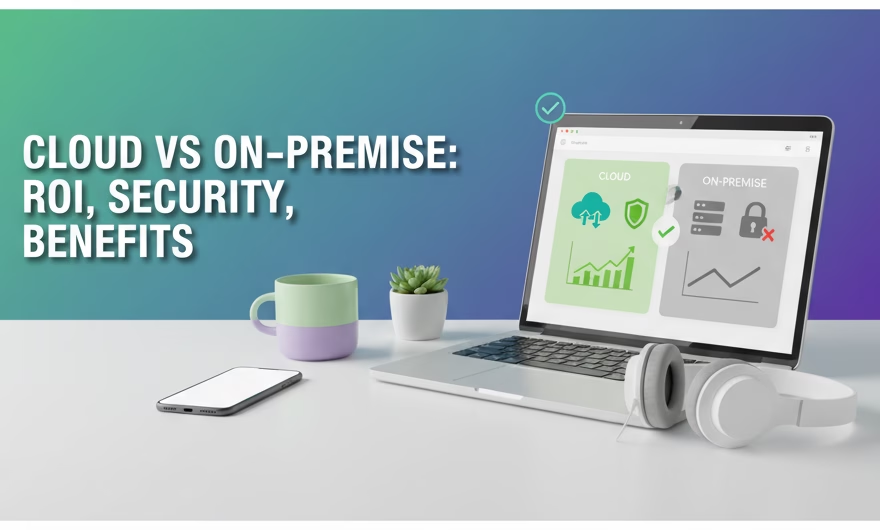






Why is cloud call center better than on-premise?
Cloud call centers reduce costs, optimize agent efficiency, and improve ROI by delivering better customer experiences and empowering employees. As customer expectations and work models continue to evolve through 2025, cloud-based contact centers have become the preferred way to modernize operations without the complexity of managing on-site infrastructure.
Cloud call centers offer several advantages over on-premise systems, including:
Cost Efficiency
Cloud call centers require minimal upfront investment as they eliminate the need for physical hardware such as PBX systems. This reduces capital expenditure and ongoing maintenance costs compared to on-premise setups. Beyond the initial savings, the economic benefits compound over time:
- Shifts spend from large capital purchases to predictable, usage-based operating expenses.
- Reduces on-site infrastructure costs for servers, power, cooling, and office space.
- Lowers IT workload for provisioning, patching, and hardware refresh cycles, translating into efficiency gains for your tech team.
- Avoids vendor-specific lock-ins tied to proprietary hardware, making costs easier to optimize as business needs change.
Together, these factors reduce total cost of ownership and free up budget to invest in customer experience innovation rather than upkeep.
Scalability and Flexibility
Cloud systems can easily scale up or down based on business needs without the long delays or infrastructure expansion required by on-premise centers. This allows rapid adaptation to changing call volumes. As of 2025, this elasticity is especially valuable for organizations that face seasonal peaks, campaign-driven surges, or rapid growth:
- Scale agents, channels, and capacity in minutes rather than weeks of procurement and installation.
- Burst capacity on demand to maintain service levels during spikes, then scale back to control costs.
- Launch new geographies or lines of business without building out local telephony or data center footprints.
- Experiment with new workflows and channels safely, without long-term infrastructure commitments.
This agility makes the cloud model a better fit for dynamic businesses and evolving customer expectations.
Ease of Deployment and Updates
Cloud call centers enable faster deployment since they don’t require complex hardware installations. They also provide automatic and seamless updates with new features and security enhancements, reducing downtime and IT overhead. Instead of scheduling disruptive upgrades and coordinating maintenance windows, you benefit from:
- Streamlined setup with prebuilt integrations, APIs, and low-code configuration.
- Continuous delivery of features like analytics, AI tools, and channel enhancements without reinstallation.
- Proactive performance optimizations and security patches managed by the provider.
- Standardized configurations and templates that accelerate rollouts across teams and locations.
The result is faster time to value, fewer operational risks, and a platform that keeps pace with technology and regulatory changes.
Remote Accessibility
Because cloud-based operations run over the internet, agents can work remotely from any location, facilitating distributed workforces and business continuity. Hybrid and remote work have become a durable reality, and cloud contact centers are designed for this environment:
- Agents, supervisors, and admins can securely access tools from anywhere via browser or mobile apps.
- Built-in controls such as SSO, MFA, IP allowlists, and role-based permissions help protect access.
- Quality assurance, coaching, and workforce management continue seamlessly with remote monitoring and live guidance.
- Disaster recovery and continuity are inherently stronger, since operations are not tied to a single physical site.
Organizations gain staffing flexibility, access to wider talent pools, and resilience against local disruptions.
Better Customer Experience
Cloud centers support omnichannel communication, real-time analytics, AI-driven features, and integrations with CRM and other business tools, enhancing the capabilities of agents to manage customer interactions effectively. As of 2025, leading cloud platforms typically offer:
- Unified routing and reporting across voice, SMS, WhatsApp, chat, email, and social channels.
- AI capabilities such as intent detection, sentiment analysis, real-time agent assist, call summarization, and automated quality scoring.
- Native integrations with popular CRMs and ticketing systems to surface customer context and history at the moment of interaction.
- Real-time and historical analytics for staffing, SLAs, and customer outcomes, enabling faster, data-driven decisions.
These capabilities empower agents to personalize interactions, resolve issues faster, and proactively meet customer needs—improving satisfaction and lifetime value.
Reliability and Security
Cloud platforms like Ameyo by Exotel offer enterprise-grade reliability with high uptime guarantees and secure environments to protect sensitive data. Modern architectures are built for resilience and governed by strong security standards:
- High availability with multi-zone or multi-region redundancy to minimize service disruption.
- Stringent SLAs backed by proactive monitoring and 24/7 support.
- Encryption in transit and at rest, granular access controls, audit logs, and configurable data retention.
- Compliance with widely recognized frameworks such as ISO 27001, SOC 2, PCI DSS, and GDPR, helping reduce regulatory risk.
Security and reliability are not afterthoughts in the cloud—they are foundational, and they scale as your business grows.
Together, these benefits result in improved operational efficiency, enhanced customer satisfaction, and reduced total cost of ownership compared to traditional on-premise call centers. The cloud model also accelerates innovation by making it easier to adopt new channels, AI features, and integrations without major infrastructure projects or downtime.
From a strategic standpoint, the difference is not just technical—it’s organizational. Cloud contact centers enable cross-functional teams to configure journeys, automate workflows, and roll out improvements quickly. Supervisors can test new IVR flows or routing strategies, operations can adjust capacity on the fly, and customer experience teams can launch campaigns across channels—all with less dependency on hardware and lengthy change cycles. This agility translates into faster response to market conditions and customer feedback.
In addition, cloud platforms are designed to interoperate. Open APIs and prebuilt connectors reduce integration complexity with CRM, marketing automation, payments, fraud detection, knowledge bases, and workforce tools. This connected approach reduces swivel-chair tasks for agents and unifies data streams for analytics, enabling a more holistic view of customer journeys and business performance.
Finally, sustainability and footprint considerations increasingly favor cloud over on-premise. Consolidating workloads with a cloud provider typically reduces the need for distributed server rooms and local telephony hardware. While every environment is unique, many organizations find that cloud operations help streamline their technology estate, simplify vendor management, and reduce the environmental and administrative overheads that come with maintaining physical infrastructure.
This comprehensive superiority of cloud call centers explains why many businesses are moving away from on-premise setups toward cloud solutions for their contact center needs. As of 2025, the cloud has become the practical path to delivering resilient, secure, and modern customer experiences—while keeping costs predictable and teams empowered to adapt quickly. For organizations seeking reliable performance, robust security, and continuous innovation, platforms like Ameyo by Exotel provide a proven foundation to build and scale exceptional customer engagement.

A marketing automation enthusiast at Exotel, passionate about building data-driven workflows that power smarter customer engagement. I bridge the gap between marketing and technology turning campaigns into scalable, automated systems that drive real business impact. When I’m not optimizing lead funnels or setting up automation flows, you’ll find me writing about customer experience, martech trends, and the future of communication on the Exotel blog.