+91-808 8919 888

 Technology & Roadmap
  January 18, 2025
  5 mins read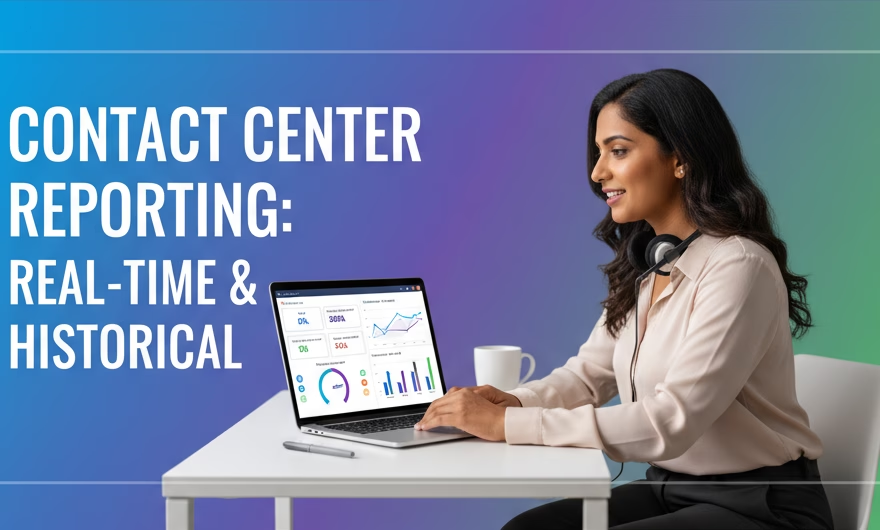






Management values numbers because monthly, quarterly, and yearly reports determine budget allocation and forecasts for future operations. However, collecting raw and unstructured data alone does not aid informed decision-making. Businesses must organize and meaningfully present data to transform it into a strategic asset.
Contact centers benefit from using both real-time and historical reporting to ensure key metrics meet targets and identify where adjustments are needed. Together, these reporting modes give supervisors and leaders the visibility they need to steer daily operations and shape long-term strategy.
Real-time reporting
Real-time reports can be accessed live during operational hours, allowing supervisors to act on what’s happening now rather than after the fact. With immediate visibility into queues, agent status, and performance against SLAs, leaders can optimize outcomes while interactions are still in progress.
For example, if a few agents are unsuccessful in making sales, a supervisor can alter the sales message, tweak dispositions, reassign leads, or adjust the dialing list immediately. If an inbound queue is breaching service levels, managers can add agents, change routing priorities, or deflect to self-service IVR options. This nimbleness helps improve campaign and service success rather than waiting until the campaign or shift ends to implement changes.
- Common real-time metrics: queue length, service level adherence, average speed of answer, live abandonment rate, agent occupancy and adherence, active calls/chats, conversion in current interval.
- Operational controls: pause/resume campaigns, change pacing on predictive dialers, route overflow to backup queues, trigger alerts on threshold breaches.
- Dashboards and alerts: wallboards for team visibility, role-based dashboards for supervisors, and configurable alerts via email/SMS for critical thresholds.
Historical reporting
Historical reporting offers a comprehensive performance analysis over longer time frames such as weekly, monthly, quarterly, or yearly periods. It provides insights into how the business performed across key metrics and the factors behind sales spikes or dips. Management uses these reports to inform decisions on future spending and investments and to forecast staffing, training, and technology needs.
Over time, historical data reveals patterns: which campaigns convert best, how seasonality affects volume, where bottlenecks occur, and which customer intents benefit most from self-service. It also supports continuous improvement initiatives by tracking the impact of changes to scripts, routing, or staffing models.
- Common historical metrics: average handle time, first contact resolution, after-call work, occupancy/utilization, conversion rate, CSAT/NPS, contact reasons, and channel mix.
- Trend analysis: period-over-period comparisons, cohort analyses (by segment or disposition), and root-cause views across processes and channels.
- Planning inputs: forecast accuracy, shrinkage analysis, capacity planning, and quality management correlations.
Benefits of reporting
- Measure marketing and sales outcomes: Compare performance across campaigns, see lead-to-opportunity conversions, and attribute outcomes to channels, creatives, or scripts.
- Sharpen strategy: Use data to prioritize investments, refine customer journeys, and identify high-impact training or automation opportunities.
- Monitor distributed teams: Gain a unified view of performance across sites and remote agents, ensuring consistent service across time zones and locations.
- Drive accountability: Transparent KPIs and role-based dashboards help teams own results while aligning to organizational goals.
- Support compliance and quality: Ensure visibility into call recording coverage, consent capture, and audit trails while linking outcomes to quality evaluations.
Integrate with CRM systems for richer insights
When integrated with CRM systems, organizations can pull up information quickly using drop-down menus and extensive filters for targeted searches. This helps correlate interaction data with customer attributes, deal stages, or support case details for more actionable analysis. Seamless integration with key contact center tools enhances functionality and reduces manual work.
- Unified customer view: Blend interaction metrics with CRM fields like lifecycle stage, segment, or campaign source.
- Flexible filters: Slice by agent, queue, disposition, region, product, intent, or customer tier to answer specific business questions.
- Closed-loop workflows: Push insights back into CRM for lead scoring, case prioritization, or automated follow-ups.
Reporting across core contact center components
A robust reporting tool connects to essential contact center components such as Predictive Dialer, Automatic Call Distributor (ACD), Interactive Voice Response (IVR), and Voice Logger. This integration enables component-specific reports that provide detailed insights into each function’s performance.
- Predictive Dialer: Track connect rates, pacing effectiveness, call attempts per lead, right-party contact rate, and conversion by list or script variant. Optimize dialing strategies without harming customer experience.
- ACD: Analyze queue performance, routing outcomes, transfer patterns, and skills utilization. Identify bottlenecks and balance load across teams and time slots.
- IVR: Measure containment rates, menu performance, and dropout points. Improve flows to deflect routine intents while preserving seamless agent escalation.
- Voice Logger: Monitor recording coverage, retrieval times, and linkage to quality scores. Ensure auditability and support coaching with easily searchable recordings.
What a modern contact center reporting tool should include
As of 2025, leading contact center reporting tools have evolved beyond static reports. They provide real-time visibility, unified omnichannel analytics, and flexible access to data while supporting governance and security needs.
Capabilities checklist
- Omnichannel coverage: Unified reporting across voice, email, chat, social messaging, and SMS to understand end-to-end journeys.
- Customizable dashboards: Drag-and-drop widgets, saved views, and role-based access so each stakeholder sees what matters most.
- Real-time alerts and thresholds: Proactive notifications when SLAs, abandonment, or occupancy breach set limits.
- Advanced filtering and drill-downs: Multi-dimensional filters with the ability to move from summary KPIs to agent-, queue-, or interaction-level details.
- Scheduled and automated reporting: Recurring report delivery to inboxes or secure locations in multiple formats (CSV, XLSX, PDF).
- Attribution and disposition analytics: Clear mapping of outcomes to sources, campaigns, and agent actions for better ROI measurement.
- Quality and coaching linkage: Tie performance metrics to quality evaluation forms, sentiment signals, and coaching plans.
- AI-assisted insights: Trend detection, anomaly highlighting, and summarization to surface what changed and why.
- WFM/WEM alignment: Metrics that support forecasting and scheduling, including adherence and productivity views.
- Open data access: Secure APIs and connectors for BI tools and data warehouses so teams can build deeper analyses.
- Data governance and compliance: Role-based permissions, PII masking, retention controls, and audit trails to meet regulatory requirements.
- Scalability and performance: Fast query response and reliable data freshness as volumes and channels grow.
How to turn reporting into action
Reports create value only when teams use them to make timely, targeted changes. Align reporting structures to operational rhythms so insights translate into outcomes.
- Daily stand-ups: Review real-time KPIs, identify bottlenecks, and assign immediate actions for staffing, routing, or coaching.
- Weekly performance reviews: Examine historical trends, compare campaigns and queues, and agree on experiments for the coming week.
- Monthly and quarterly planning: Use aggregated data to refine forecasts, budgets, and technology investments.
- Continuous improvement loops: Close the loop by measuring the impact of changes and iterating based on new data.
- Transparency and accountability: Share role-based dashboards so agents, team leads, and executives stay aligned on goals and progress.
Building a holistic reporting foundation
A holistic approach to reporting blends real-time and historical views, integrates with CRM and core contact center components, and provides the tools to drill down from outcomes to root causes. With robust governance and flexible access, teams can trust the data and act quickly.
Ameyo by Exotel’s contact center capabilities align with these principles by emphasizing integration across dialers, ACD, IVR, and voice logging, while enabling customizable and actionable reporting. When your reporting tool becomes the single source of operational truth, every function—from marketing and sales to service and compliance—can make better decisions, faster.
Conclusion
A robust contact center reporting tool is essential for turning raw interaction data into strategic outcomes. Real-time dashboards empower swift, on-the-floor decisions, while historical analyses guide long-term planning and investment. By integrating with CRM and core components like Predictive Dialer, ACD, IVR, and Voice Logger, and by supporting omnichannel analytics, alerting, and governance, reporting delivers the actionable intelligence required to improve operations, enhance marketing effectiveness, and optimize resources. With the right reporting foundation in place, contact centers can consistently meet targets, adapt with agility, and elevate customer experience.

A marketing automation enthusiast at Exotel, passionate about building data-driven workflows that power smarter customer engagement. I bridge the gap between marketing and technology turning campaigns into scalable, automated systems that drive real business impact. When I’m not optimizing lead funnels or setting up automation flows, you’ll find me writing about customer experience, martech trends, and the future of communication on the Exotel blog.