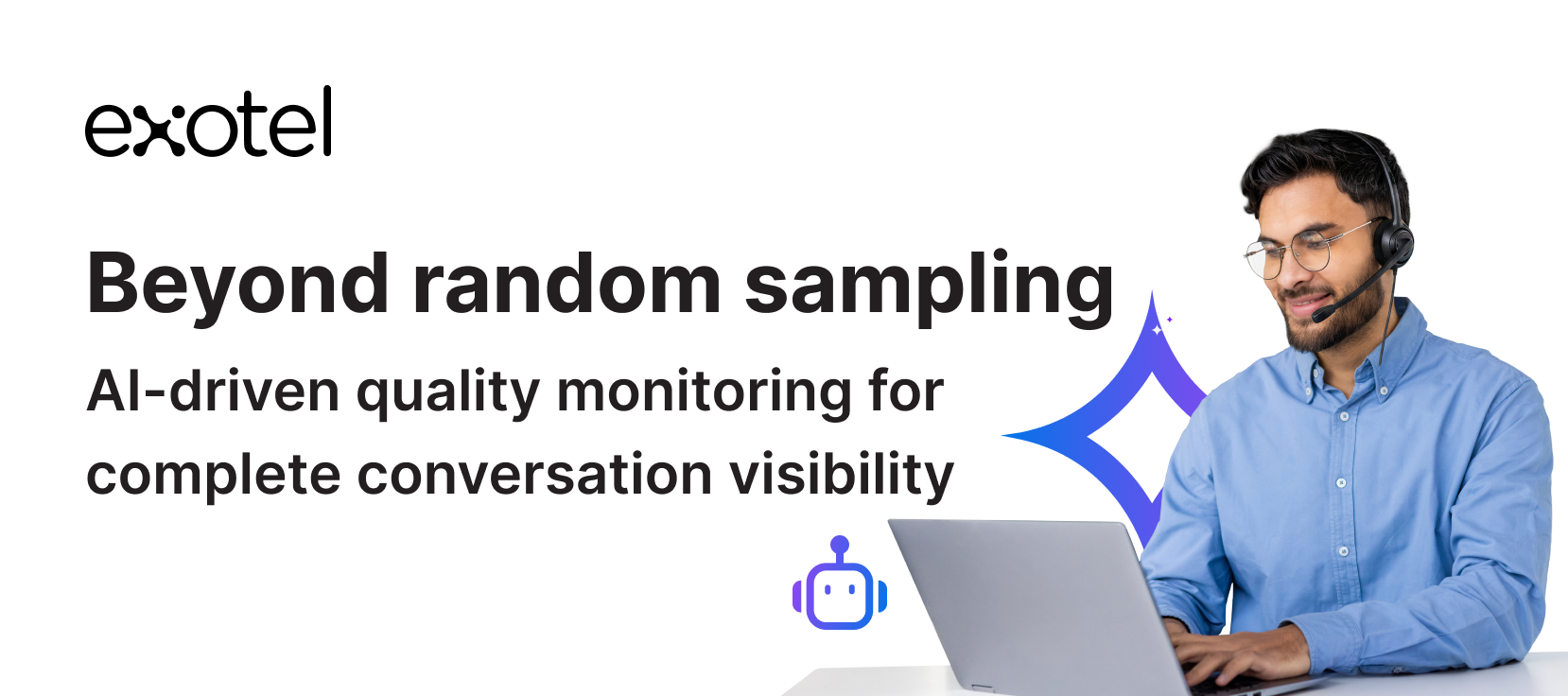




Here’s a number that should make every contact center leader uncomfortable: most quality assurance teams monitor between 2% and 5% of customer conversations.
That means 95–98% of interactions are a black box. Nobody listened. Nobody reviewed. Nobody knows whether the agent followed protocol, the customer left satisfied, or a compliance violation occurred.
Now consider the implications. Your QA team reviews perhaps 10 calls per agent per month. Those 10 calls become the entire basis for performance evaluations, coaching decisions, and compliance assurance. If the agent happened to have a good day when the calls were sampled, their score looks great. If they had a bad day, their score tanks. Neither is a reliable picture.
And it’s not the QA team’s fault. They’re doing the best they can with the time they have. A supervisor who monitors 30 agents simply cannot listen to every call. Manual quality assurance is, by definition, a sampling exercise. And sampling at 2–5% is not a strategy — it’s a lottery.
At Exotel, we built Advanced Quality Monitoring (AQM) into the Harmony Platform to eliminate this blind spot entirely. AQM uses AI to analyse 100% of customer conversations — every call, every chat, every interaction — in real time and after the fact.
The Five Limitations of Manual Quality Assurance
Before we get into what AI-powered monitoring looks like, it’s worth understanding exactly why traditional QA falls short. The problems are structural, not personnel:
- Statistically insignificant sample sizes
Monitoring 2–5% of interactions provides a confidence level that no statistician would endorse. If an agent handles 400 calls a month and a supervisor reviews 10, that’s a 2.5% sample. Even if those 10 calls are randomly selected, the margin of error is enormous. Patterns — good or bad — are invisible at this scale. - Selection bias
In practice, calls aren’t randomly selected. Supervisors tend to review flagged calls (complaints, long durations), skip short or routine ones, and gravitate toward agents they’re already concerned about. The sample is biased before the first call is played. - Subjectivity and inconsistency
Two supervisors can evaluate the same call and arrive at different scores. Quality criteria are often subjective (“Did the agent show empathy?”), and scoring depends on who’s listening, their mood, their relationship with the agent, and their interpretation of the rubric. Consistency across a QA team is the exception, not the norm. - Delayed feedback
Manual QA is retrospective. A call from Tuesday might be reviewed on Friday. The feedback reaches the agent the following week. By then, they’ve handled hundreds more calls using the same behaviour patterns. The coaching moment has passed. The impact is diluted. - Anxiety over coaching
When agents know that a handful of their calls will be randomly scrutinised, the monitoring process feels more like surveillance than development. QA becomes a source of anxiety rather than a tool for improvement. Agents dread the “you had a score of 72 this month” conversation, and the entire process takes on a punitive flavour — even when that’s not the intent.
The core issue is scarcity. When you can only afford to review a tiny fraction of interactions, every review carries disproportionate weight, every missed issue stays hidden, and the entire QA programme is built on a foundation of incomplete information.
What 100% Conversation Analysis Looks Like
AI-powered quality monitoring analyses every customer conversation — voice calls, chats, and messaging interactions — automatically, checking for compliance adherence, agent behaviour quality, customer sentiment, and resolution outcomes across 100% of interactions.
In Harmony’s AQM module, this works by running AI analysis on top of the same real-time conversation data that powers the rest of the platform (the CCDP). The AI doesn’t need a separate recording or a separate transcript. It reads from the same context layer that bots, agents, and supervisors use.
Here’s what the AI evaluates on every interaction:
- Compliance checks: Did the agent follow mandatory scripts? Were required disclosures made? Was customer consent obtained where needed? Was sensitive data handled according to policy? Were regulatory requirements (HIPAA, PCI-DSS, GDPR, RBI guidelines) met? The AI checks every applicable rule on every interaction — not a random sample.
- Agent behaviour quality: Did the agent greet properly? Did they demonstrate active listening? Was the tone appropriate for the situation? Did they follow the prescribed resolution flow? Were there unnecessary holds or transfers? The AI evaluates against your quality rubric, consistently and without subjective drift.
- Customer sentiment and outcome: Did the customer’s sentiment improve, deteriorate, or stay flat over the course of the interaction? Was the issue resolved? Did the customer express satisfaction or dissatisfaction? Were there signals that the customer may call back (indicating incomplete resolution)?
- Conversation efficiency: Was the handle time appropriate for the complexity? Were there avoidable delays (long holds, unnecessary transfers, slow system lookups)? Did the agent use available tools effectively (did they follow the agent assist suggestions, for instance)?
The output isn’t a numerical score and a voicemail from a supervisor. It’s structured, actionable intelligence — available in real time to supervisors, team leads, and the agents themselves.
Manual QA vs. AI-Powered Quality Monitoring
The difference isn’t incremental. It’s a category shift.
| Manual QA (2–5% Coverage) | AI-Powered AQM (100% Coverage) |
|---|---|
| Supervisor reviews 10–20 calls per agent per month | AI analyses every conversation for every agent, automatically |
| Selection bias — flagged or long calls overrepresented | No selection bias — every interaction is evaluated equally |
| Subjective scoring varies between reviewers | Consistent criteria applied uniformly across all interactions |
| Feedback delivered days or weeks after the interaction | Issues flagged in real time or within hours |
| Compliance checked on a sample; violations may go undetected for months | Compliance checked on every interaction; violations flagged immediately |
| QA team spends hours listening to calls | QA team reviews AI-flagged issues, spends time coaching instead of listening |
| Agent experience: anxiety, feels like surveillance | Agent experience: continuous feedback, feels like coaching |
| Patterns invisible at 2–5% sample | Patterns across agents, teams, topics, and time periods are visible and quantifiable |
From Policing to Coaching: How AQM Changes the QA Relationship
This is perhaps the most transformative aspect of AI-powered quality monitoring, and it’s the one that’s hardest to appreciate from a feature list: it fundamentally changes the relationship between QA and agents.
In the traditional model, QA is perceived as policing. A supervisor listens to a handful of calls, identifies mistakes, assigns a score, and delivers feedback. The agent feels judged. The conversation is backward-looking (“On this call from Tuesday, you forgot to…”). The dynamic is evaluative and often adversarial.
When 100% of conversations are monitored, the dynamic shifts:
- Feedback becomes continuous, not periodic. Instead of a monthly score based on 10 calls, agents receive ongoing feedback based on every interaction. This normalises feedback as part of the workflow, not a rare event to dread.
- Feedback becomes specific, not general. The AI can identify exactly which conversations had issues, what the specific issue was, and what the ideal behaviour would have been. “On 14 of your billing calls this week, you didn’t mention the fee waiver option” is far more actionable than “your quality score is 72.”
- Feedback can be real-time. For critical issues — a compliance violation, a customer in distress, a conversation heading off the rails — AQM can flag the issue while the interaction is still live. The supervisor can intervene or the agent can self-correct in the moment, not days later.
- Coaching is data-driven. Supervisors no longer spend their time listening to random calls. They spend it reviewing AI-flagged patterns and coaching agents on specific, data-backed improvement areas. The supervisor’s role evolves from auditor to coach.
The Agent’s Perspective
When every call is monitored equally, there’s no longer a feeling of “will this be the one they listen to?” The randomness — and the anxiety that comes with it — disappears. Agents know that the system sees everything, which paradoxically feels less stressful than being randomly sampled. Because the feedback is continuous and specific, it feels like coaching rather than judgment. And because the data covers hundreds of interactions rather than ten, one bad call doesn’t define their month.
For new agents, AQM accelerates ramp-up dramatically. Instead of waiting weeks for a supervisor to review enough calls to identify coaching needs, the AI surfaces patterns from the first day. “This new agent consistently forgets the identity verification step” appears by day three, not month two. The coaching intervention happens before the bad habit solidifies.
Closing the Loop: QA Data Improves Bots Too
In most contact centers, quality monitoring is a purely human-facing process. You evaluate agents. You coach agents. The AI side of the operation — bots, automation, self-service flows — lives in a separate world.
In Harmony, AQM data feeds back into the entire platform:
- Bot improvement: If the AI detects that agents consistently handle a certain query type differently (and better) than the bot, that pattern signals a gap in the bot’s capabilities. The insight feeds into the Kaizen continuous improvement loop — the bot’s scripts or knowledge get updated based on what works in human hands.
- Agent assist refinement: Quality data reveals which agent assist suggestions are being used effectively and which are being ignored. If agents consistently override the AI’s next-best-action recommendation for a particular scenario, that’s a signal the recommendation needs updating.
- Routing optimisation: AQM can identify which types of interactions lead to poor outcomes when handled by certain agents or teams. This feeds into smarter routing — matching interaction types to agents who handle them best.
- Training content gaps: Patterns in quality data reveal where training materials are insufficient. If multiple agents struggle with the same policy or process, the issue isn’t individual performance — it’s a training gap. AQM surfaces these systematically.
This is what makes AQM a platform capability rather than a standalone QA tool. It doesn’t just evaluate quality — it generates the intelligence that drives improvement across every part of the operation — human and AI alike.
Compliance Without Compromise
In regulated industries, quality monitoring isn’t a nice-to-have. It’s a regulatory requirement. Financial services firms must ensure disclosures are made. Healthcare organisations must verify patient consent processes. Insurance companies must follow mandated claims procedures. Telecom providers must comply with consumer protection scripts.
The traditional approach — spot-checking 2–5% of calls — is a compliance liability masquerading as a compliance programme. If a regulator asks “How do you ensure every customer interaction meets compliance requirements?”, the honest answer is: we don’t. We check a small sample and hope for the best.
AQM changes this answer to: we check every single interaction, automatically, in real time.
Specifically, AQM provides:
- 100% compliance coverage: Every interaction is checked against applicable regulatory and policy requirements. Not a sample. Every one.
- Immediate violation detection: When a compliance issue is detected, it’s flagged instantly — not discovered during a quarterly audit. The violation can be addressed while the customer relationship is still recoverable.
- Audit-ready records: Every interaction’s compliance status is logged with the conversation context. When the regulator asks for evidence, you have a complete record — not a sample with gaps.
- Policy enforcement for AI interactions: AQM doesn’t just monitor human agents. It also monitors bot-handled conversations. If the AI skips a required disclosure or handles sensitive data improperly, the system flags it just as it would for a human. This is critical as AI handles a growing share of interactions — the compliance net must cover both sides.
For enterprises in BFSI, healthcare, and insurance, AQM transforms compliance from a retrospective audit exercise into a real-time assurance system. Combined with the AMCC framework from Blog 4, it creates a governance layer that makes AI deployment viable even in the most stringently regulated environments.
What Happens to the QA Team?
A reasonable concern is: if AI monitors everything, what do QA supervisors do?
The answer is: more valuable work than they’ve ever done.
When supervisors stop spending hours listening to random calls, their role elevates:
- Review AI-flagged issues: Instead of finding problems, supervisors review problems the AI has already identified. They validate the AI’s assessment, decide on the appropriate response, and deliver targeted coaching.
- Analyse patterns: Supervisors can now see patterns across the entire operation — which agents struggle with which interaction types, which policies cause the most confusion, which times of day quality dips. These insights were invisible at 2–5% coverage.
- Design interventions: With complete data, supervisors can design targeted coaching programmes, update training materials, recommend process changes, and collaborate with product teams on bot improvements. Their role shifts from evaluator to architect of quality.
- Focus on exceptions: The AI handles the baseline monitoring. Supervisors focus on the edge cases, the nuanced situations, the judgment calls that AI can’t make alone. Their expertise is applied where it has the most impact.
QA teams don’t become redundant. They become strategic. The drudgery of random call listening is automated away, and their time is redirected to the work that actually improves the operation.
Stop Sampling. Start Seeing.
The gap between monitoring 3% of conversations and monitoring 100% isn’t a quantitative improvement. It’s a qualitative shift in how you understand and manage your contact center.
At 3%, you’re guessing. You’re extrapolating from fragments. You’re hoping that the calls you didn’t listen to were fine.
At 100%, you’re seeing. You know what’s happening across every agent, every channel, every interaction type. You know where quality is strong, where it’s weak, and exactly what to do about it. Compliance isn’t a hope — it’s a verified fact. Coaching isn’t based on 10 calls — it’s based on all of them.
That’s what AI-powered quality monitoring delivers. Not more of the same. A fundamentally different way to ensure, improve, and scale quality across your entire customer operation.
And because AQM feeds its insights back into the rest of the Harmony Platform — improving bots, refining agent assist, optimising routing, and driving the Kaizen continuous improvement loop — it doesn’t just measure quality. It actively raises it.
This is the sixth article in our AI–Human Harmony series. Next up: how every conversation makes the next one better — the feedback loops and continuous learning engine that turn a contact center into a self-improving system.
Frequently Asked Questions
What is AI-powered quality monitoring in a contact center?
AI-powered quality monitoring uses artificial intelligence to analyse 100% of customer conversations — calls, chats, and messaging interactions — for compliance adherence, agent behaviour quality, customer sentiment, and resolution outcomes. It replaces the traditional model of supervisors manually reviewing 2–5% of interactions, providing complete coverage with consistent evaluation criteria.
How does AI quality monitoring improve on manual QA?
Manual QA suffers from five structural limitations: tiny sample sizes (2–5%), selection bias, subjective and inconsistent scoring, delayed feedback, and an anxiety-inducing dynamic for agents. AI monitoring eliminates all five: it evaluates every interaction, consistently, with immediate feedback, turning QA from a periodic judgment into continuous coaching.
Can AI quality monitoring work in real time?
Yes. In Exotel’s Harmony Platform, the AQM module can flag critical issues — compliance violations, customer distress, conversations going off track — while the interaction is still live. This allows supervisors to intervene or agents to self-correct in the moment, rather than discovering problems days or weeks after the fact.
How does AI quality monitoring help with regulatory compliance?
AQM checks every interaction against applicable regulatory and policy requirements automatically. Compliance violations are flagged immediately, not discovered during quarterly audits. Every interaction’s compliance status is logged for audit-ready records. This transforms compliance from a sampling-based hope to a verified, real-time assurance system.
Does AI quality monitoring replace QA supervisors?
No. It elevates their role. Instead of spending hours listening to random calls, supervisors review AI-flagged issues, analyse patterns across the full operation, design targeted coaching programmes, and focus their expertise on edge cases and judgment calls that AI can’t handle alone. Their work shifts from auditing to architecting quality.
Does AQM monitor AI-handled conversations as well as human-handled ones?
Yes. AQM monitors both human agent interactions and bot-handled conversations. If the AI skips a required disclosure, handles sensitive data improperly, or produces a poor outcome, the system flags it just as it would for a human agent. As AI handles a growing share of interactions, this dual coverage is essential for maintaining quality and compliance.