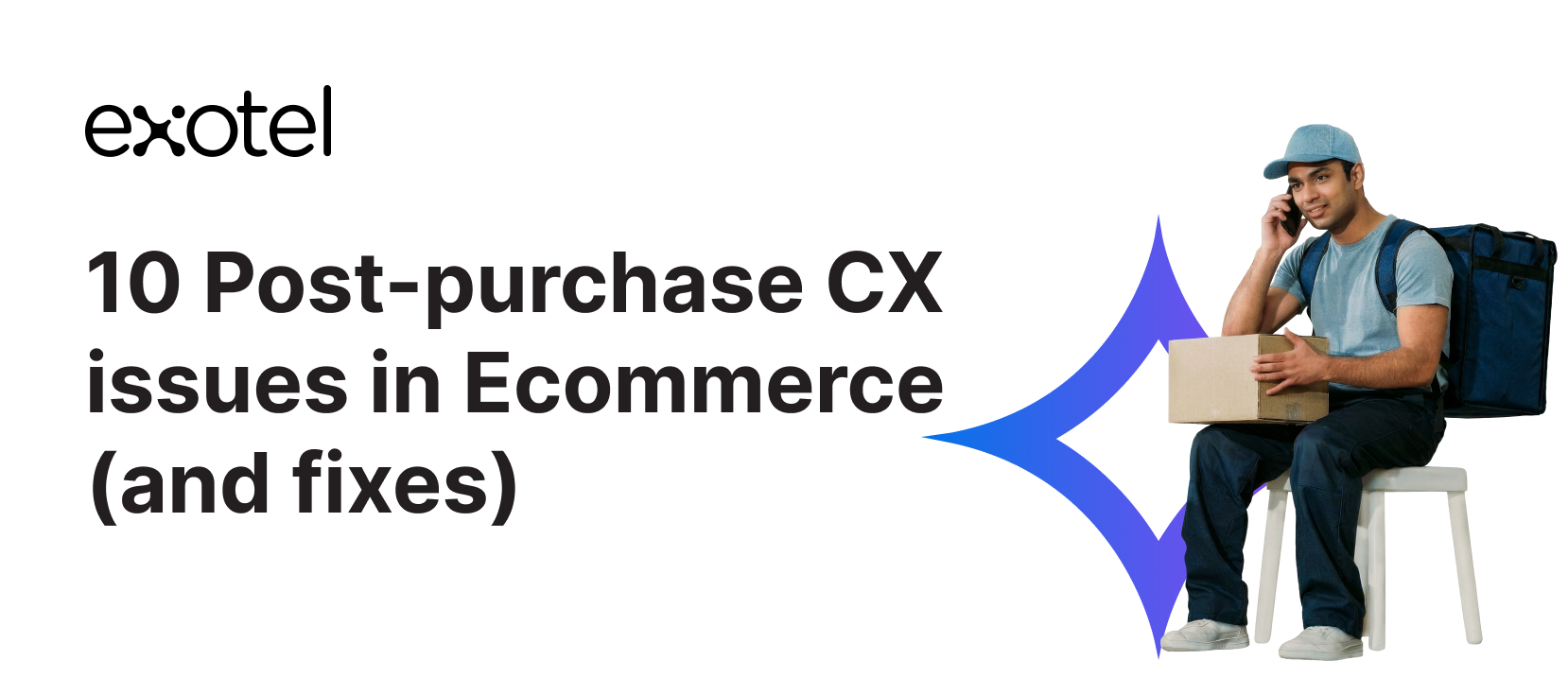




The order confirmation email has been sent. The sale is done. But for your customer, the journey is just beginning — and for too many brands, this is exactly where things fall apart.
We obsess over conversion. We A/B test landing pages, optimize checkout flows, and pour budgets into acquisition. Yet a striking paradox persists across ecommerce: the moment a customer completes a purchase is often the moment brands stop paying attention.
This is a costly mistake.
Research consistently shows that the post-purchase experience is the single strongest predictor of customer lifetime value, repeat purchase rate, and word-of-mouth. A customer who feels well-supported after buying spends more, returns more, and refers more. A customer who feels abandoned files chargebacks, leaves one-star reviews, and takes their next order to a competitor.
The post-purchase window — from order placed to product delivered and beyond — is where brand loyalty is either cemented or destroyed.
At Exotel, we work with hundreds of ecommerce brands to power their customer communication infrastructure. Through this partnership with Shiprocket — India’s leading ecommerce shipping and fulfillment platform — we’ve observed firsthand what separates brands that retain customers from those that hemorrhage them. Shiprocket helps thousands of D2C brands, SMBs, and enterprises streamline logistics operations by integrating with marketplaces, storefronts, and multiple courier partners to automate order processing and enable real-time shipment tracking. Combined with intelligent customer engagement on our end, this creates the foundation for exceptional post-purchase experiences.
But infrastructure is only half the equation. The other half is execution. Here are the ten most common problems killing post-purchase CX — and what high-growth brands are doing differently.
1. The Black Hole After Checkout
The Problem: A customer places an order and then… silence. Hours or even days pass with no meaningful update. They don’t know if their order was received, when it shipped, or where it is. Anxiety builds. Support tickets start flowing in: “Did my order go through?” This is the most preventable problem in ecommerce — and the most common.
The Fix: Proactive communication is non-negotiable. Automated order confirmations, dispatch alerts, and out-for-delivery notifications should fire in real time across the channels your customer actually uses — SMS, WhatsApp, or email. The goal isn’t just to inform; it’s to reassure. Every proactive update you send is one less support call you receive and one more moment of trust you build. Brands using omnichannel customer engagement platforms can orchestrate this entire notification layer without manual effort, ensuring no customer is left wondering.
2. Generic “Your Order Has Shipped” Emails That Nobody Reads
The Problem: Transactional messages have become so templated and forgettable that customers have trained themselves to ignore them. A plain-text email with a tracking number buried in a wall of legalese isn’t communication — it’s noise.
The Fix: Treat every post-purchase touchpoint as a brand moment. Dynamic, personalized messaging that includes the customer’s name, a visual summary of what they ordered, an estimated delivery window, and a direct link to live tracking converts a mundane notification into a delightful experience. The best brands go further — using these messages to surface relevant cross-sell recommendations or loyalty points updates, turning transactional emails into engagement opportunities.
3. Customers Who Can’t Reach You When Something Goes Wrong
The Problem: A package is delayed. A product arrived damaged. A customer got the wrong size. These moments happen. What defines your brand is not whether problems occur, but how quickly and gracefully you resolve them. If your support is hard to reach — buried behind a web form, a 48-hour email queue, or an IVR maze that dead-ends at a voicemail — you are failing at the most critical juncture in the customer relationship.
The Fix: Make support effortless and instant. Customers should be able to reach your team on their channel of choice — WhatsApp, phone, live chat — without friction. Intelligent routing that connects the right customer to the right agent based on purchase history, issue type, and priority dramatically reduces resolution time. For ecommerce brands handling high volumes, cloud-based contact center solutions that unify all these channels into a single agent view aren’t a luxury — they’re the foundation of scalable CX.
4. Delivery Failures With No Recovery Plan
The Problem: Failed deliveries are more common than brands like to admit — customers not at home, address errors, logistics partner issues. What’s far less common is a swift, proactive recovery. Most brands leave the customer to figure it out themselves, navigating the carrier’s website and their own frustration simultaneously.
The Fix: Automate failed-delivery workflows. The moment a delivery attempt fails, trigger an outreach — an SMS or WhatsApp message that acknowledges the miss, provides rescheduling options, and makes it easy for the customer to respond with their preference. A two-way conversational message that lets a customer reply “2” for tomorrow’s delivery slot transforms a frustrating moment into a demonstration of operational excellence. Brands that close this loop proactively see significantly higher delivery success rates on subsequent attempts and near-zero escalations.
5. The Return and Refund Black Hole
The Problem: Returns are a fact of ecommerce life — particularly in categories like fashion, electronics, and beauty. But many brands treat the return process as an afterthought: clunky portals, opaque policies, long refund timelines, and zero communication after the return is initiated. Customers are left to wonder for days whether their refund is coming.
The Fix: Build a returns experience that’s as seamless as your purchase experience. Automated return confirmation messages, real-time refund status updates, and proactive ETA communication turn what is inherently a negative interaction into a trust-building one. Data shows that customers who have a frictionless return experience are more likely to purchase again than customers who never had an issue. The return isn’t the end of the relationship — it’s an opportunity to prove your brand values the customer over the transaction.
6. Ignoring the Customer After Delivery
The Problem: The product arrives. The delivery is marked complete. And most brands consider the job done. This is a missed opportunity of enormous proportions. The post-delivery window — when the customer has the product in hand and is forming their final impression — is one of the highest-leverage moments in the entire customer lifecycle.
The Fix: Design a thoughtful post-delivery engagement sequence. A check-in message 24–48 hours after delivery — asking if the product arrived as expected and inviting any questions — signals that you care beyond the sale. Pair this with a well-timed review request (not immediately, not three weeks later — about three to five days post-delivery for most categories), and you have a systematic way to both gather feedback and build brand advocates. Automated yet personalized, this kind of outreach requires almost no manual effort when built into your customer communication stack.
7. Support Agents With No Context
The Problem: A customer calls in to ask about their delayed order. The agent asks them to repeat their order number, their address, and the issue. The customer, who is already frustrated, now has to re-explain everything from scratch — possibly for the second or third time. This fragmented experience signals organizational dysfunction and amplifies customer frustration at exactly the wrong moment.
The Fix: Context-aware support is table stakes. When a customer reaches out, your agent should immediately see their order history, past interactions, delivery status, and any open issues — all in one place. Customer engagement platforms that integrate with your OMS and logistics stack create this unified view, enabling agents to greet customers with “I can see your order #4521 was supposed to arrive yesterday — let me check on that for you right now.” That single sentence transforms the experience from frustrating to impressive.
8. Language and Channel Barriers in Diverse Markets
The Problem: India’s ecommerce market is phenomenally diverse — in language, digital literacy, and channel preference. A Tier-1 city customer might expect WhatsApp updates and a slick chat experience. A first-time buyer in a Tier-3 city might be more comfortable with a phone call in their regional language. Brands that offer only English communication through a single channel are leaving a massive portion of their customers underserved.
The Fix: Build for the India stack, not just the metro stack. Multi-language communication — in Hindi, Tamil, Telugu, Bengali, Marathi, and beyond — dramatically increases engagement rates in non-English-speaking markets. Offering voice, SMS, and WhatsApp as distinct channels (not just the same message pushed everywhere) meets customers where they actually are. The brands that crack regional-language CX at scale will win disproportionate loyalty in the next wave of ecommerce growth.
9. No Feedback Loop From Post-Purchase Data
The Problem: Customer complaints, returns, failed deliveries, and escalations contain a wealth of product and operational intelligence. But most brands don’t systematically analyze this data. A pattern of returns citing “product not as described” is a content problem. Repeated complaints about a specific logistics partner are an ops problem. Without a feedback loop, the same problems recur endlessly.
The Fix: Close the loop between your CX data and your product, operations, and marketing teams. Tag and categorize support tickets, return reasons, and feedback responses. Review this data in weekly business reviews. Customer-facing teams should be the early-warning system for everything from product quality issues to listing inaccuracies to fulfillment problems. Brands that operationalize this feedback loop improve faster and retain customers better than those that treat support data as a cost center metric rather than a strategic asset.
10. Treating Post-Purchase CX as a Cost, Not a Growth Driver
The Problem: Perhaps the most systemic failure: post-purchase experience is still budgeted and staffed as pure overhead by many ecommerce brands. Support headcount is minimized, communication tools are the cheapest available, and the entire function is measured only by cost-to-serve. The result is a predictable race to the bottom — and customer churn that is invisible until it shows up in retention metrics quarters later.
The Fix: Reframe post-purchase CX as a revenue function. The data is clear: increasing customer retention by just 5% can increase profits by 25–95%, according to research from Bain & Company. Every resolved complaint, every proactive notification, every frictionless return is an investment in the customer relationship — and that relationship has a measurable lifetime value. Brands that allocate properly to post-purchase infrastructure — intelligent communication platforms, unified support tools, analytics — see measurable improvements in NPS, repeat purchase rate, and average order value over time.
The Bigger Picture: CX Is the New Moat
In an ecommerce landscape where product commoditization is real, logistics is table stakes, and paid acquisition costs keep rising, the post-purchase experience is one of the last genuine competitive moats available to brands.
Your customers don’t just want their orders delivered — they want to feel heard, valued, and confident that if something goes wrong, someone will make it right. That feeling is manufactured in the small moments: the timely message, the empathetic agent, the proactive update, the smooth return.
The best post-purchase experiences happen when logistics infrastructure and customer communication work in concert. When your fulfillment platform provides real-time visibility into every shipment and simplifies returns management, and your engagement platform turns that data into proactive, personalized customer outreach — that’s when the magic happens. It’s why partnerships like ours with Shiprocket matter: together, we help brands deliver not just products, but the reliability and responsiveness that builds long-term customer relationships.
The brands that are winning on retention in India’s ecommerce market today are not necessarily the ones with the best products or the lowest prices. They are the ones who have invested in making the customer feel like they matter — not just at the moment of purchase, but at every touchpoint that follows.
Post-purchase CX isn’t a support problem. It’s a growth strategy.