
AI Voice Generator
What Is an AI Voice Generator?
An AI voice generator is a system that synthesises human-like speech from input, typically written text, though advanced systems also accept audio prompts for voice cloning or speech-to-speech conversion. The output is a natural-sounding audio stream that can be delivered in real time (for conversational AI and contact centres) or rendered as a file (for content production, audiobooks, e-learning).
The technology has progressed through three distinct eras:
- Concatenative TTS (pre-2016): Pre-recorded voice fragments stitched together by rule-based systems. Output sounded robotic and lacked natural rhythm.
- Statistical Parametric TTS (2016-2019): Statistical models generated speech parameters, producing smoother but still synthetic-sounding output.
- Neural TTS / AI Voice Generation (2019-present): Deep neural networks trained on hours of real human speech generate audio from scratch, capturing intonation, stress, emotional nuance, and speaking style. Output is frequently indistinguishable from human speech in blind listening tests.
How an AI Voice Generator Works: Step-by-Step
Step 1: Text Preprocessing and Linguistic Analysis The input text is normalised, and numbers, abbreviations, and symbols are expanded (‘Rs. 1,200’ becomes ‘one thousand two hundred rupees’). Sentence structure is parsed to identify phrase boundaries, and grapheme-to-phoneme (G2P) conversion maps written words to phonetic representations, handling exceptions and context-dependent pronunciation.
Step 2: Prosody Prediction A neural model predicts the prosody of speech: which syllables to stress, where to pause, how pitch rises and falls across a sentence. This is what separates natural-sounding AI voice from robotic output. Transformer-based prosody models learn these patterns from thousands of hours of annotated human speech.
Step 3: Acoustic Modelling The prosody-annotated phoneme sequence is passed to an acoustic model (such as FastSpeech 2, VITS, or a proprietary neural architecture) that generates a mel spectrogram, a visual representation of the audio’s frequency content over time.
Step 4: Waveform Synthesis (Vocoder) A neural vocoder (WaveNet, HiFi-GAN, or similar) converts the mel spectrogram into a raw audio waveform, the actual sound file. Modern vocoders produce broadcast-quality audio at 22kHz or 44kHz sampling rates.
Step 5: Delivery The synthesised audio is delivered via streaming (WebSocket for real-time applications) or file download (WAV, MP3 for content production). Real-time AI voice systems target first-audio-chunk latency under 300ms to maintain conversational flow.
Types of AI Voice Generation
- Text-to-Speech (TTS): Converts written text to speech using a pre-built voice model. Primary use case: IVR, voice bots, content narration.
- Voice Cloning: Replicates a specific speaker’s voice from a short audio sample (as little as 30 seconds). Primary use case: brand voice creation, personalised assistants.
- Speech-to-Speech: Converts one voice’s speech into another voice in real time, bypassing text. Primary use case: live voice conversion, dubbing.
- Emotion-Controlled TTS: Generates speech with a specified emotional tone (empathetic, authoritative, excited). Primary use case: customer service bots, e-learning.
- Multilingual TTS: Single model generates speech across multiple languages and accents. Primary use case: global contact centres, multilingual IVRs.
Key Benefits of AI Voice Generators
- Eliminates Recording Dependency: Content that previously required studio sessions and voice talent can be generated programmatically in seconds, reducing production timelines from days to minutes.
- Infinite Scalability: An AI voice generator handles one call or one million simultaneously, with no degradation in quality or consistency. This is foundational for contact centre automation at scale.
- Voice Consistency Across Touchpoints: A single cloned or designed brand voice delivers identical tone, pacing, and personality across IVR, outbound calls, chatbot audio responses, and marketing content.
- Multilingual Reach Without Re-Recording: The same voice model generates speech in Hindi, Tamil, Telugu, Kannada, English, and other languages from the same text input, enabling regional customer engagement without rebuilding voice assets.
- Cost Reduction: AI voice generation eliminates per-minute voice talent costs, studio hire, and post-production editing. For high-volume contact centre applications, cost per audio-minute drops by 90% or more compared to recorded prompts.
- Real-Time Personalisation: Dynamic TTS can insert customer-specific data (name, account number, transaction amount) into synthesised speech in real time, enabling personalised voice interactions at scale impossible with pre-recorded audio.
- Rapid Iteration: Updating an IVR prompt or notification message requires only a text edit and re-synthesis, not a re-recording session. Businesses can update voice content in hours rather than weeks.
AI Voice Generator Use Cases
Contact Centre IVR and Voice Bots AI-generated voices replace pre-recorded IVR prompts, enabling dynamic, context-aware menus that can adapt to caller input, personalise responses with the caller’s name or account data, and update instantly when business information changes. Unlike recorded prompts, TTS-based IVR never sounds dated or mismatched.
Outbound Notification Campaigns Banks, logistics companies, and healthcare providers use AI voice generators to place millions of outbound calls, including payment reminders, appointment confirmations, and delivery alerts, with synthesised speech personalised per recipient, delivered at a cost per call far below human-agent or recorded-prompt alternatives.
Conversational AI Agents Every voice assistant and voice bot requires a TTS engine to respond to users. The quality of the AI voice generator directly determines whether the interaction feels natural or jarring. Low-latency neural TTS is the difference between a fluid conversation and one interrupted by robotic pauses.
E-Learning and Training Content L&D teams use AI voice generators to produce narrated training modules, refreshed with updated content as policies or products change, without needing to re-engage narrators for every revision.
Accessibility Screen readers powered by neural TTS give visually impaired users a significantly better experience than robotic synthesised speech, improving comprehension and reducing cognitive load.
Content Production Podcasters, video producers, and publishers use AI voice generation for rapid narration, translated audio versions of written content, and voiceovers for markets where human voice talent is expensive or unavailable.
AI Voice Generator vs TTS: What Is the Difference?
Text-to-speech (TTS) is the broader technology category, any system that converts text to speech. AI voice generator is a more specific, capability-forward term referring to neural TTS systems enhanced with features like voice cloning, emotion control, and multilingual synthesis. All modern AI voice generators use TTS as their core engine, but not all TTS systems qualify as full AI voice generators.
- Voice Quality: Basic TTS is acceptable but limited in naturalness; an AI voice generator is human-like and emotionally expressive.
- Voice Cloning: Not supported in basic TTS; supported in AI voice generators (as little as 30 seconds of audio).
- Emotion Control: None in basic TTS; configurable in AI voice generators (empathy, urgency, excitement).
- Languages: Basic TTS is limited and accent-heavy; AI voice generators are multilingual with natural accent modelling.
- Latency: Basic TTS is higher and often batch-only; AI voice generators offer sub-300ms streaming for real-time use.
- Personalisation: Basic TTS is static text-to-audio; AI voice generators are dynamic with name/data injection.
Key Metrics for AI Voice Generator Quality
- Mean Opinion Score (MOS): Listener-rated naturalness on a 1-5 scale. Human speech scores approximately 4.5. Top neural TTS systems reach 4.2-4.4.
- Word Error Rate (WER) of Downstream ASR: A proxy for how accurately ASR systems can transcribe TTS-generated speech. Lower is better.
- First-Chunk Latency: Time from API request to first audio byte. Target: under 300ms for real-time conversational use.
- Real-Time Factor (RTF): Ratio of generation time to audio duration. RTF below 1.0 means generation is faster than playback, which is required for streaming.
- Voice Cloning Similarity Score: Cosine similarity between speaker embeddings of the original and cloned voice. Top systems achieve 0.85+ similarity.
AI Voice Generation in India: Market and Regulatory Context
- India’s linguistic diversity, with 22 officially recognised languages and hundreds of dialects, requires voice models trained on regionally representative data, not just generic Hindi or English.
- Code-switching (mixing Hindi and English mid-sentence) is standard in urban Indian speech and must be handled gracefully by enterprise TTS systems.
- TRAI guidelines govern automated voice communications, including consent requirements for outbound AI-generated calls.
- India’s DPDP Act (2023) applies to voice data used for voice cloning; consent and data minimisation principles must be followed.
Keep exploring

Elevate Customer Experiences with GenAI powered Voice Bot
Transform customer engagement with our AI Voice Assistant. More than a bot, it’s your conversational partner, fluent in Hindi, English, and Hinglish. Available 24/7, it learns continuously for meaningful, personalised interactions.
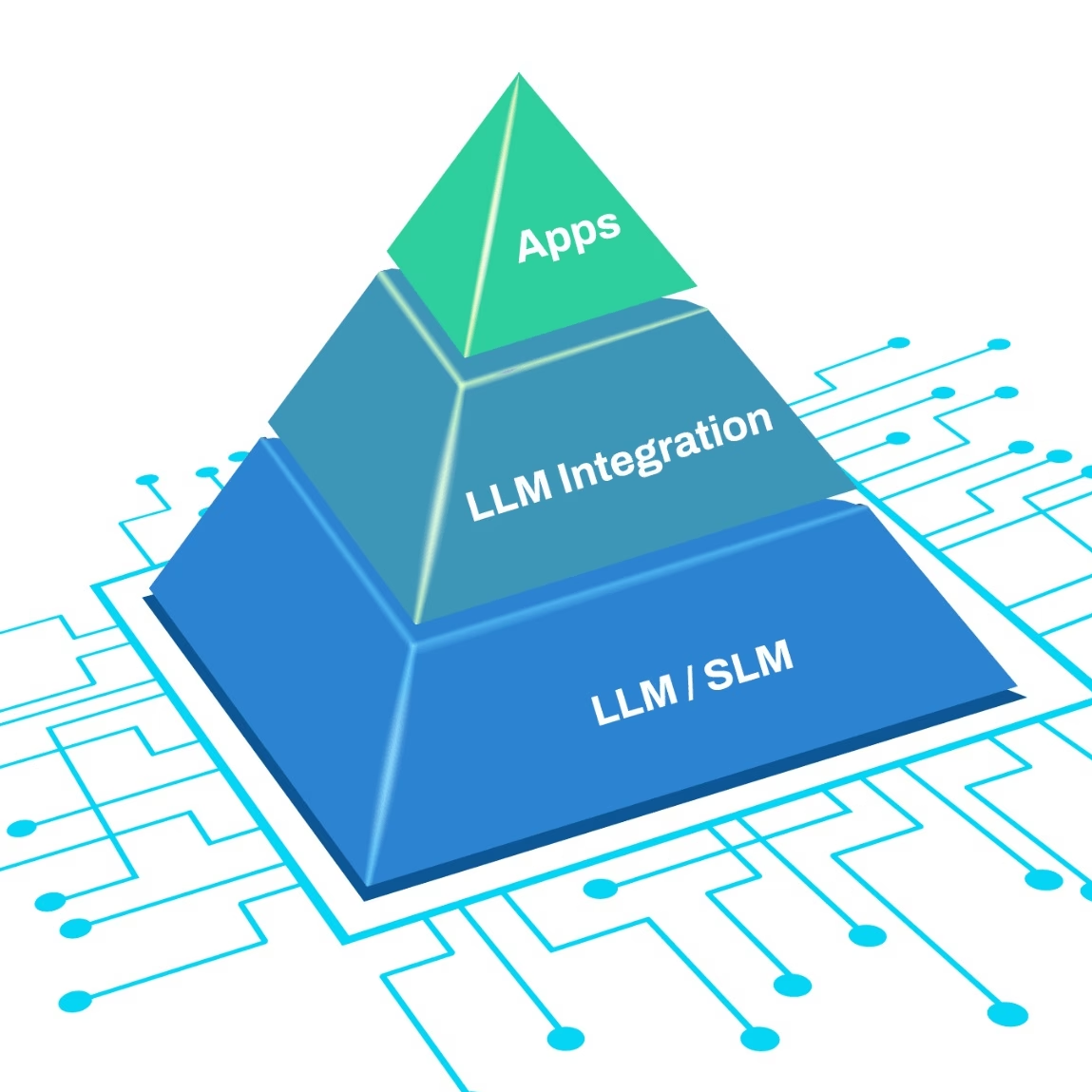
Hub of advanced AI technologies for modern conversational AI.
Utilizing Gen AI and Natural Language Processing (NLP) capabilities, the House of AI transforms customer conversations into engaging, human-like experiences. It goes deep into understanding context, sentiment, and intent, enabling dynamic, personalized responses that boost engagement and loyalty.

Enabling conversations with documents and knowledge bases to enhance productivity.
At Exotel, we understand the frustration of support engineers, service managers, IT personnel, sales representatives and customers when placed on hold. ExoInsights provides users with just the right and relevant answer, tailored to their specific queries. It simplifies access to accurate information, making the decision-making process more efficient and user-friendly.

AI-powered Conversation Quality Analysis tool
Automate cross-channel conversation quality analysis against your SOPs and KPIs to maintain top-tier service quality and agent efficiency, effortlessly.