
AI IVR: Definition & How It Works
What is AI IVR?
AI IVR, short for Artificial Intelligence Interactive Voice Response, is an interactive voice response system that uses speech recognition and natural language understanding to interpret what a caller wants, then routes, answers, or resolves the call without a fixed keypad menu. Where a traditional IVR says “press 1 for billing, press 2 for technical support,” an AI IVR listens to what the caller actually says, works out the intent behind it, and either resolves the request directly or routes the call to the right person with the conversation already summarized.
The word that changes is the middle one. Traditional IVR responds to keystrokes. AI IVR responds to intent. A caller can say “I need to update the card on my account” in their own words, and the system understands the request, looks up the account, and either handles it or hands it to someone who can, without making the caller navigate a menu tree first.
Key characteristics
- Natural language input: accepts any spoken phrase, with no button menus or “say your account number” prompts required.
- Intent-based routing: maps what the caller says to the right destination or resolution, rather than to a fixed menu position.
- End-to-end resolution for common queries: handles account lookups, status checks, FAQs, and simple transactions directly, without involving a person.
- Contextual handoff: when escalation is needed, passes the full transcript and identified intent to the receiving agent, so the caller doesn’t repeat themselves.
- Dynamic updates: changes take effect by updating the underlying knowledge base or configuration, not by re-recording audio prompts or rebuilding a call tree.
How AI IVR works
A call to an AI IVR system runs through a short pipeline, usually completing each step within a couple of seconds:
- Speech to text: automatic speech recognition (ASR) converts the caller’s spoken words into text in real time.
- Intent and entity recognition: natural language understanding reads that text to identify the caller’s intent and any relevant details, such as an account number, a date, or an order ID.
- Decision and action: the system checks a CRM or backend system if needed, then either answers directly, completes a simple transaction, or decides where to route the call.
- Text to speech: the response is converted back into a natural-sounding voice and played to the caller.
- Escalation and handoff: if a person is needed, the system passes along a summary, the identified intent, and any details already collected, so the agent doesn’t start from zero.
Unlike a traditional IVR, where every new call flow or policy change requires re-recording prompts and rebuilding menu logic, an AI IVR typically updates by editing the underlying knowledge base or configuration, so changes can go live without touching audio files or call trees.
AI IVR vs traditional IVR
The two systems differ across several dimensions:
- Input: a traditional IVR takes keypad presses (DTMF) or single keywords; AI IVR takes natural, open-ended speech.
- Navigation: a traditional IVR follows a fixed decision tree that’s the same for every caller; AI IVR follows a dynamic, intent-based path that adapts to what’s said.
- Unscripted requests: a traditional IVR hits a dead end or transfers the caller; AI IVR interprets the request and handles or routes it appropriately.
- Routing logic: a traditional IVR routes based on the menu position selected; AI IVR routes based on the caller’s actual intent and context.
- Making changes: a traditional IVR requires re-recording prompts and rebuilding the call tree; AI IVR is updated by editing the knowledge base or configuration.
- Caller effort: a traditional IVR requires the caller to listen, choose, and often repeat information later; AI IVR lets the caller state the need once, in their own words.
For simple, stable call flows with low volume, a traditional menu can still be perfectly adequate and cheaper to run. AI IVR earns its cost when call reasons vary widely, volume is high, and a wrong turn in a fixed menu means an abandoned call or a repeat contact.
AI IVR vs conversational IVR vs AI voice agent
These three terms overlap and are often used loosely, but they describe different scopes:
- Conversational IVR describes the caller-facing experience: the natural, back-and-forth voice interface someone talks to. It’s about how the call feels.
- AI IVR describes the underlying system: the intent recognition, data lookups, and routing logic that decide what happens with what the caller said. It’s the engine behind the experience.
- AI voice agent (sometimes called an AI receptionist) describes a fuller, more autonomous system that can run an entire interaction end to end, including outbound calls and complete self-service, going well beyond replacing a menu.
In practice, a well-implemented AI IVR is functionally close to an AI voice agent. The difference is often the starting point: teams replacing an existing IVR tend to search for “AI IVR,” while teams building a phone channel from scratch tend to search for “AI voice agent.” Two vendors can both use the term “AI IVR” and mean different amounts of the call, so it’s worth checking exactly what happens on a live call rather than relying on the label alone.
Use cases
- Department and queue routing: a caller states their reason for calling in their own words, and the system routes them to billing, technical support, or sales without making them guess which numbered option applies.
- Account self-service: checking a balance, order status, delivery date, or appointment time is answered directly using data pulled from a backend system, without tying up a live agent.
- Pre-transfer information capture: before connecting a caller to an agent, the system collects account numbers, the reason for the call, or other identifying details, so the agent opens the call with context instead of asking the caller to repeat themselves.
- After-hours and overflow handling: when no agents are available, AI IVR can still resolve simple queries or take a structured message, rather than leaving the caller with only a voicemail option.
- High-volume seasonal spikes: during peaks such as billing cycles or sale periods, AI IVR absorbs a larger share of repetitive queries so wait times for calls that genuinely need a human stay shorter.
Benefits
- Shorter call handling time: callers reach the right destination or get an answer in one step instead of listening through several menu levels.
- Lower cost per call: queries resolved without a live agent free up staff time for calls that need human judgment. Industry estimates for containment, the share of calls resolved end-to-end without a human, commonly range from around 20% to 40% for a typical deployment, with mature, well-tuned systems reaching higher.
- Consistent first response: every caller gets the same accurate starting point, regardless of call volume or time of day.
- Reduced abandonment: callers are less likely to hang up out of frustration with a long, rigid menu tree.
- Better data on call reasons: because the system interprets what callers actually say, it produces more precise data on why people are calling than a menu selection alone would.
Limitations of AI IVR
AI IVR is not a full replacement for human judgment, and it’s worth being clear-eyed about where it struggles:
- Novel, emotional, or multi-part requests: a caller describing several problems at once, or one who is upset, is usually still better served by a person than by intent-matching logic.
- Dependence on integration and data quality: the system is only as good as the backend it queries; if a CRM record is wrong or a system is unavailable, the AI IVR can confidently act on bad information.
- Speech recognition isn’t perfect: accents, background noise, and cross-talk on real phone lines can still cause misrecognition, even with modern speech models.
- No judgment for sensitive situations: decisions involving negotiation, exceptions, or emotionally sensitive circumstances need a person, not an intent-matching system.
The practical goal is to automate the routine, route everything else accurately, and make sure the handoff to a human carries full context, not to eliminate human agents from the call entirely.
Frequently asked questions
Is AI IVR the same as an AI voice agent?
They’re closely related but not identical in scope. “AI IVR” usually describes replacing or upgrading an existing phone menu system. “AI voice agent” usually describes a broader capability that can run a full conversation end to end, including outbound calls. A well-built AI IVR is often functionally close to an AI voice agent; the terms mainly differ in what problem the buyer started with.
How long does it take to implement an AI IVR system?
Straightforward deployments covering a handful of call types with one or two backend integrations typically go live in a few weeks. More complex rollouts, with many call types, strict compliance requirements, or multiple system integrations, can take a few months. Most teams phase in call types gradually rather than switching over all at once.
What happens to calls the AI IVR can’t handle?
Requests outside the system’s configured scope are escalated to a human agent. A properly configured AI IVR passes along the transcript, the identified intent, and any details already collected, so the caller doesn’t have to re-explain their issue from the start.
Do customers know they’re talking to AI?
Most deployments disclose upfront that the caller is speaking with an AI system, and in some jurisdictions this disclosure is required. Customer frustration with AI phone systems tends to come from failed resolution or being stuck in a loop, not simply from knowing it’s AI; callers who get a quick, accurate resolution generally rate the experience well regardless.
Is AI IVR secure enough for regulated industries like healthcare or finance?
It can be, with the right controls in place: encryption in transit and at rest, role-based access, clear handling of recording consent, and relevant certifications for the industry. Security depends on how the system is configured and operated, so this is worth confirming directly rather than assuming based on the label “AI IVR” alone.
Keep exploring

Elevate Customer Experiences with GenAI powered Voice Bot
Transform customer engagement with our AI Voice Assistant. More than a bot, it’s your conversational partner, fluent in Hindi, English, and Hinglish. Available 24/7, it learns continuously for meaningful, personalised interactions.
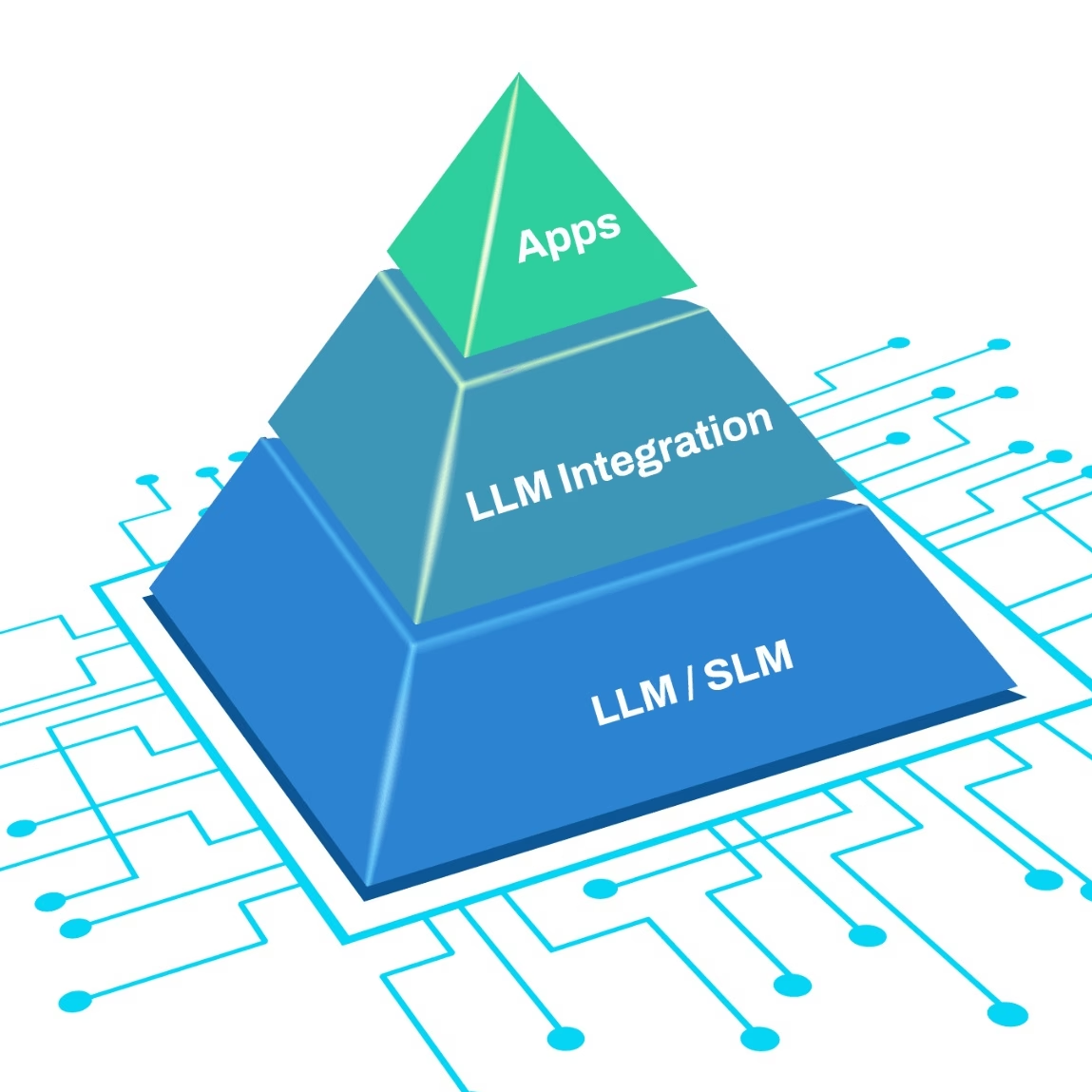
Hub of advanced AI technologies for modern conversational AI.
Utilizing Gen AI and Natural Language Processing (NLP) capabilities, the House of AI transforms customer conversations into engaging, human-like experiences. It goes deep into understanding context, sentiment, and intent, enabling dynamic, personalized responses that boost engagement and loyalty.

Enabling conversations with documents and knowledge bases to enhance productivity.
At Exotel, we understand the frustration of support engineers, service managers, IT personnel, sales representatives and customers when placed on hold. ExoInsights provides users with just the right and relevant answer, tailored to their specific queries. It simplifies access to accurate information, making the decision-making process more efficient and user-friendly.

AI-powered Conversation Quality Analysis tool
Automate cross-channel conversation quality analysis against your SOPs and KPIs to maintain top-tier service quality and agent efficiency, effortlessly.