
WebSocket Audio Streaming
What is WebSocket Audio Streaming?
WebSocket audio streaming is a method of sending live call audio back and forth over a single, persistent connection, rather than through the traditional telephony transport (RTP over SIP) that carries a normal phone call, or through repeated one-off API requests. It’s the mechanism that lets a voice AI system, an STT engine, an LLM, a TTS engine, receive a caller’s audio in small chunks as they speak and send generated speech back in near real time, instead of waiting for a full recording to be transferred and processed after the fact.
How the connection actually works
A WebSocket connection starts life as an ordinary HTTP request. That request is then upgraded, using a standard handshake, into a lasting, two-way channel between client and server. Because it begins as HTTP, it passes through most firewalls and proxies without special configuration, which is part of why it’s become the default choice for streaming media rather than a more exotic protocol. Once the upgrade completes, either side can send data at any time with no new handshake, and audio frames flow continuously in both directions over that one open connection.
Why WebSockets specifically, and not polling or webhooks
Live call audio is a constant flow, not a set of discrete events, and that shape of data determines which transport actually fits:
- Polling means repeatedly asking “is there new audio yet?” on a schedule, which adds latency between when audio exists and when it’s picked up, and wastes requests when there’s nothing new to send.
- Webhooks are built for single, occasional events, a call started, a call ended, not for a continuous stream of audio frames arriving many times per second.
- WebSockets keep one connection open and push frames through it the moment they’re generated, which is the only one of the three that suits a nonstop flow of audio without adding structural delay.
This is why voice streaming infrastructure built for AI voice agents is typically built on WebSockets rather than polling an API or waiting on webhook events.
How it typically works in a voice AI pipeline
- Call bridging: the telephony platform, connected via SIP trunk, bridges the live call audio into a WebSocket stream rather than only routing it as a standard RTP call leg.
- Chunked audio frames: audio is sent as small chunks, commonly every 20 milliseconds, as binary frames carrying raw or encoded audio bytes, often alongside metadata like timestamps and which party, caller or agent, the audio belongs to.
- Bidirectional flow: the caller’s audio streams in one direction toward the AI backend for transcription, while synthesized speech from the text-to-speech engine streams back in the other direction, both over the same connection.
- Event metadata: alongside raw audio, the stream typically carries events like call start, call end, and marks for when the AI has finished speaking a given response, so the receiving system knows what it’s listening to and when.
Why this matters for latency
Streaming audio in small chunks rather than waiting for a complete utterance is one of the biggest levers for reducing voice AI latency. A well-built WebSocket streaming setup can deliver audio end-to-end in the low hundreds of milliseconds, letting an LLM built for voice agents and a speech recognition engine start working on the first few hundred milliseconds of audio while the caller is still talking, rather than waiting for them to finish the whole sentence before any processing begins. That said, the transport delay is only part of the total conversation latency; the processing time for speech recognition, response generation, and speech synthesis on top of it also counts toward what the caller actually experiences.
What to plan for operationally
A persistent connection behaves differently from a one-off API call, and a production voice AI setup needs to account for that:
- Reconnection with backoff: networks drop connections; a resilient integration reconnects automatically rather than dropping the call’s audio entirely.
- Buffering for short gaps: brief network hiccups shouldn’t translate into audible gaps or lost audio if a small buffer is in place.
- Backpressure handling: if the receiving system (an STT engine, for example) falls behind the incoming audio rate, the pipeline needs a defined way to handle that rather than silently dropping frames.
- Stream shape: whether caller and agent audio arrive as one mixed channel or as separate channels per party changes how much downstream work, like speaker separation, is needed before transcription.
Use cases
- Real-time voice AI agents, streaming live call audio to an STT, LLM, and TTS pipeline and back, with minimal added delay.
- Live call transcription, feeding audio to a transcription engine as a call happens rather than after it ends.
- Bring-your-own AI stacks, where a business wants to plug its own STT, LLM, or TTS vendor into a telephony platform via a standard voicebot API rather than being locked into one vendor’s bundled AI.
Benefits
- Lower conversational latency: chunked, continuous streaming lets downstream AI components start processing before a caller finishes speaking.
- Flexible AI stack composition: a single, standardized streaming interface lets a business swap in different STT, LLM, or TTS providers without changing the underlying telephony integration.
- Simpler scaling: a persistent connection per call is generally lighter-weight to manage at scale than establishing new connections for every short audio exchange.
FAQs
How is WebSocket audio streaming different from webhooks?
Webhooks send each event as its own one-off HTTP request, which works well for occasional events like a call starting or ending. WebSockets keep one connection open and push a continuous flow of audio through it, which is what a live conversation actually needs.
What latency should I expect from WebSocket audio streaming?
A well-built setup typically delivers audio end-to-end in the low hundreds of milliseconds. The total delay a caller experiences also includes whatever processing, speech recognition, response generation, speech synthesis, happens on top of that transport time.
Does WebSocket audio streaming work over the public internet reliably?
Yes, though like any real-time protocol it’s sensitive to network conditions. Providers typically run the AI backend in infrastructure close to the telephony platform, and build in reconnection and buffering logic, to keep the experience reliable despite ordinary network variability.
Keep exploring
Elevate Customer Experiences with GenAI powered Voice Bot
Transform customer engagement with our AI Voice Assistant. More than a bot, it’s your conversational partner, fluent in Hindi, English, and Hinglish. Available 24/7, it learns continuously for meaningful, personalised interactions.
Hub of advanced AI technologies for modern conversational AI.
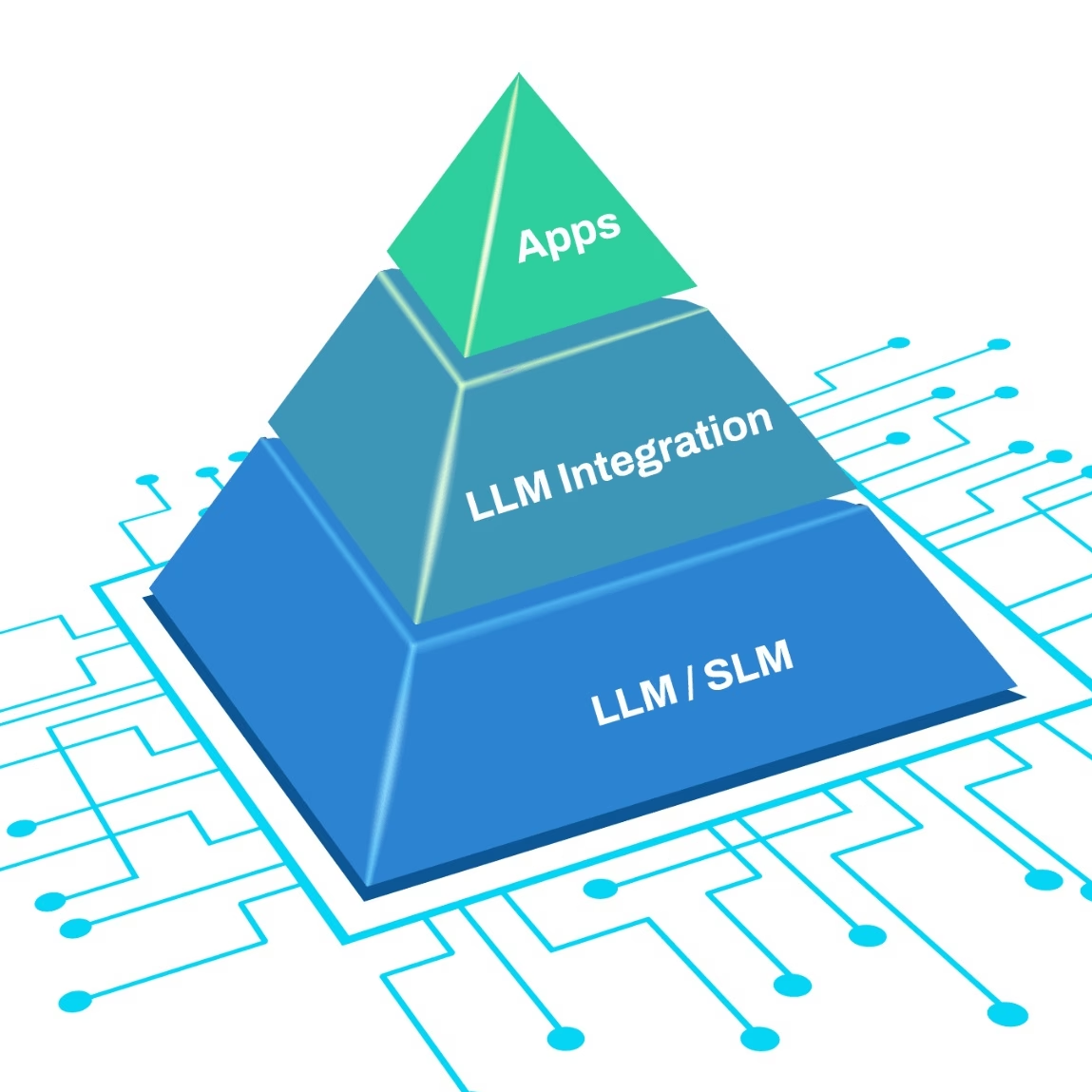
Utilizing Gen AI and Natural Language Processing (NLP) capabilities, the House of AI transforms customer conversations into engaging, human-like experiences. It goes deep into understanding context, sentiment, and intent, enabling dynamic, personalized responses that boost engagement and loyalty.

Enabling conversations with documents and knowledge bases to enhance productivity.
At Exotel, we understand the frustration of support engineers, service managers, IT personnel, sales representatives and customers when placed on hold. ExoInsights provides users with just the right and relevant answer, tailored to their specific queries. It simplifies access to accurate information, making the decision-making process more efficient and user-friendly.
AI-powered Conversation Quality Analysis tool
Automate cross-channel conversation quality analysis against your SOPs and KPIs to maintain top-tier service quality and agent efficiency, effortlessly.