
Voice Assistant: Definition & How It Works
What is a Voice Assistant?
A voice assistant (also called a voice AI, voice bot, or conversational IVR) is a software application that uses a combination of Automatic Speech Recognition (ASR), Natural Language Understanding (NLU), dialogue management, and Text-to-Speech (TTS) synthesis to simulate human-like voice interaction.
Voice assistants process spoken input, determine user intent, retrieve relevant information or trigger downstream actions (API calls, database lookups, system commands), and respond in natural-sounding synthesised speech, all within a latency window that maintains conversational flow (typically under 1-2 seconds end-to-end).
The technology has evolved from rigid, keyword-based IVR systems (‘Press 1 for billing’) to sophisticated conversational AI agents capable of handling multi-turn dialogues, clarifying ambiguous queries, managing context across a conversation, and handing off to human agents with full context when needed.
How Voice Assistants Work: The Technology Stack
1. Automatic Speech Recognition (ASR)
ASR converts spoken audio into text. Modern ASR engines use deep neural networks (typically transformer-based models like Wav2Vec 2.0 or Whisper) trained on millions of hours of speech data. Key performance metrics include Word Error Rate (WER); the best enterprise ASR systems achieve WER below 5% for clear speech in supported languages.
Challenges include accented speech, background noise, domain-specific vocabulary (medical terms, product names, account numbers), and code-switching (mixing languages mid-sentence), common in multilingual markets like India.
2. Natural Language Understanding (NLU)
NLU processes the ASR transcript to extract:
- Intent: What the user wants to do. ‘I want to check my balance’ becomes intent: account_balance_inquiry.
- Entities: Specific pieces of information. ‘My account number is 1234’ becomes entity: account_number = ‘1234’.
- Sentiment: Emotional tone of the utterance (positive, neutral, frustrated) used to trigger escalation or empathy responses.
- Context: In multi-turn dialogues, NLU tracks what was said in previous turns to resolve pronouns and references.
3. Dialogue Management
The dialogue manager governs the flow of the conversation, deciding what the voice assistant should say or do next, given the current intent, extracted entities, dialogue history, and business logic. Modern dialogue managers use state machine frameworks, slot-filling for structured data collection, and LLM-backed reasoning for open-ended queries.
4. Backend Integration
Most voice assistant actions involve API calls to backend systems (CRM lookup, payment gateway, inventory system, knowledge base, or ticketing tool). The speed of these integrations (sub-200ms response) is critical for maintaining conversational latency budgets.
5. Text-to-Speech (TTS)
TTS converts the assistant’s text response into natural-sounding speech. Neural TTS systems (Google WaveNet, Amazon Polly Neural, ElevenLabs) produce voice indistinguishable from human speech for most use cases. Voice cloning enables businesses to create brand-consistent voice personas.
Types of Voice Assistants
- Consumer Voice Assistants: General-purpose, device-embedded AI voice interfaces. Examples: Siri, Alexa, Google Assistant, Cortana.
- Enterprise / Contact Centre Voice AI: Domain-specific, telephony-integrated conversational AI for customer service. Examples: Exotel VoiceAI, Nuance, Google CCAI, Amazon Connect AI.
- Conversational IVR: Replaces touch-tone IVR with natural language input while still following structured flows. Examples: most cloud contact centre platforms.
- Voice-Enabled Chatbots: Chatbot dialogue models exposed via voice channel rather than text. Examples: WhatsApp Voice, web click-to-call bots.
- In-App Voice Assistants: Embedded in mobile apps for hands-free navigation or query handling. Examples: banking apps, food delivery apps.
Voice Assistant vs Traditional IVR
- Input Method: Traditional IVR uses DTMF keypress (Press 1, Press 2); a voice assistant uses natural speech (‘I want to change my address’).
- Menu Depth: Traditional IVR uses a fixed tree up to 5-6 levels deep; a voice assistant has no menus and relies on intent-driven navigation.
- Flexibility: Traditional IVR is rigid and requires the caller to follow structure; a voice assistant handles unexpected queries, rephrasing, and corrections.
- Personalisation: Traditional IVR offers minimal personalisation based on DNIS/CLI; a voice assistant offers full CRM integration personalised by history.
- Self-Service Rate: Traditional IVR self-serves 20-40% of calls; a voice assistant reaches 50-80% with well-trained NLU models.
- Caller Satisfaction: Traditional IVR is often frustrating and associated with ‘IVR hell’; a voice assistant delivers higher CSAT when designed well.
- Cost to Build: Traditional IVR is low cost and available on most platforms; a voice assistant is higher cost and requires NLU training and dialogue design.
Voice Assistant Use Cases in Business
Customer Service Automation
Voice assistants handle Tier 1 queries autonomously, including balance inquiries, order status, appointment scheduling, password resets, and FAQ responses. Industry benchmarks indicate well-designed voice AI systems achieve 60-80% query resolution without human escalation.
Outbound Notifications & Reminders
AI-initiated outbound calls notify customers of appointment reminders, payment due dates, OTP delivery, or delivery status. The voice assistant delivers the message and handles common responses (confirm/reschedule) without human agent involvement.
Collections & Debt Recovery
Conversational voice AI contacts customers about overdue payments, negotiates payment plans, and takes payment commitments while maintaining compliance with TRAI guidelines on calling hours and DND lists.
Lead Qualification
Inbound sales lines use voice AI to ask qualifying questions, capture prospect details, score leads, and route qualified opportunities to the appropriate sales representative, reducing the burden on human agents for low-intent enquiries.
BFSI: KYC & Verification
Voice assistants in banking handle identity verification through voice biometrics or knowledge-based authentication (KBA), reducing friction in account opening, loan servicing, and complaint registration.
Healthcare: Appointment Scheduling & Symptom Triage
Healthcare voice AI handles appointment booking, rescheduling, prescription refill requests, and basic symptom triage, escalating to clinical staff only for complex or high-risk cases.
Key Performance Metrics for Voice Assistants
- Containment Rate: Percentage of calls fully handled by voice AI without human escalation. Target: 60-80% for well-trained systems.
- Intent Recognition Accuracy: Percentage of utterances where the correct intent is identified. Target: greater than 90%.
- Word Error Rate (WER): Percentage of words incorrectly transcribed by ASR. Target: under 5% for primary language.
- Task Completion Rate: Percentage of sessions where the caller’s goal is achieved. Distinct from containment, as a call can be contained but task incomplete.
- Escalation Rate: Percentage of calls transferred to human agents. Low escalation is desirable, but not if it means forced containment.
- Average Handling Time (AI AHT): Time from call start to resolution by AI. Usually 40-60% shorter than human AHT for equivalent queries.
- CSAT for AI Sessions: Post-call satisfaction rating for AI-handled calls. Should approach human CSAT as models mature.
- Latency / Response Time: Time between caller utterance end and AI response start. Target: under 1.5 seconds for natural conversation.
Key Benefits of Voice Assistants for Businesses
- 24/7 Availability Without Agent Cost: Voice AI handles customer queries at 2 AM on a public holiday with the same quality as peak hours, eliminating the cost and operational complexity of staffing night shifts or managing surge capacity.
- Dramatic Cost Reduction: A well-deployed voice AI system handling 60-70% of inbound call volume autonomously can reduce contact centre operational costs by 30-50%. The cost per AI-handled interaction is typically 5-10x lower than the cost of a human-handled call.
- Consistent, Error-Free Responses: Unlike human agents who may deviate from scripts, forget disclosures, or provide inconsistent information when fatigued, voice AI delivers the same calibrated response every time, critical for regulated industries like banking and insurance.
- Instant Scalability: A voice AI system handles 10 concurrent calls or 10,000 with no infrastructure change and no hiring cycle. This is transformative for businesses with seasonal or event-driven call volume spikes.
- Reduced Average Handle Time: AI-handled interactions are typically 40-60% shorter than equivalent human-handled ones for structured queries such as account balance, order status, and appointment scheduling, because AI doesn’t engage in small talk, navigate uncertain menus, or place callers on hold to look up information.
- Zero Wait Time for Self-Service Calls: Callers resolved by voice AI experience zero queue time; they are answered instantly and resolved within the AI session. This is the single largest driver of CSAT improvement in voice AI deployments.
- Continuous Improvement Through Data: Every voice AI session generates structured data (intents, entities, fallback rates, and containment outcomes) that feeds model retraining cycles, making the system progressively more accurate without human intervention.
- Seamless Human Escalation with Context: When voice AI escalates to a human agent, the agent receives a structured summary of the AI conversation (intent, entities captured, and actions taken), eliminating the most frustrating customer experience: repeating yourself after waiting in a queue.
Voice AI & Large Language Models (LLMs)
The integration of LLMs (GPT-4, Claude, Gemini) into voice assistant architectures is transforming what’s possible:
- Generative Responses: Instead of selecting from pre-scripted response templates, LLM-backed voice AI generates contextually appropriate answers to open-ended questions.
- Reduced Training Data Requirements: LLMs generalise from pre-training; domain fine-tuning requires far less labelled data than traditional NLU model training.
- Dynamic Conversation Flows: LLMs handle unexpected conversational paths without falling through to a ‘Sorry, I didn’t understand’ dead end.
- Summarisation for Agent Handoff: When escalating to a human agent, the LLM generates a concise summary of the AI conversation, eliminating the need for customers to repeat themselves.
However, LLM-based voice AI introduces new challenges: hallucination risk (generating incorrect information), latency (LLM inference adds 200-800ms), and cost at scale. Hybrid architectures (structured flows for high-frequency intents, LLM for open-ended queries) are currently the enterprise best practice.
Regulatory Considerations for Voice AI
- Disclosure Requirements: Regulations in multiple jurisdictions (EU AI Act, proposed TRAI guidelines) require disclosure when a caller is interacting with an AI system, not a human.
- Call Recording Consent: AI-generated call recordings require the same consent obligations as human-agent recordings.
- Data Retention: Voice data processed by ASR may contain PII. Retention and deletion obligations under GDPR and India’s DPDP Act apply.
- Bias & Fairness: ASR systems can have higher error rates for certain accents or demographic groups. Enterprise deployments should audit WER across population segments.
Exotel’s Voice AI Capabilities
Exotel offers an AI Voice agent which can be deployed across the globe.
- Multilingual ASR: Support for 10+ Indian languages with custom vocabulary for domain adaptation across banking, insurance, e-commerce, and healthcare.
- Conversational IVR: Replace touch-tone IVRs with natural language flows, dramatically improving caller experience and self-service rates.
- Outbound Voice AI Agents: Fully autonomous AI agents for outbound notification, collections, and appointment campaigns, handling end-to-end conversations at scale.
- Live Agent Assist: Real-time ASR and NLU during human agent calls, surfacing relevant knowledge base articles, compliance prompts, and next-best-action suggestions.
- Seamless Escalation: Intelligent escalation to human agents with full conversation summary and CRM context, ensuring zero customer repetition.
- Analytics & Continuous Improvement: Every voice AI session is analysed for intent accuracy, containment, and CSAT, powering model retraining cycles.
Keep exploring

Elevate Customer Experiences with GenAI powered Voice Bot
Transform customer engagement with our AI Voice Assistant. More than a bot, it’s your conversational partner, fluent in Hindi, English, and Hinglish. Available 24/7, it learns continuously for meaningful, personalised interactions.
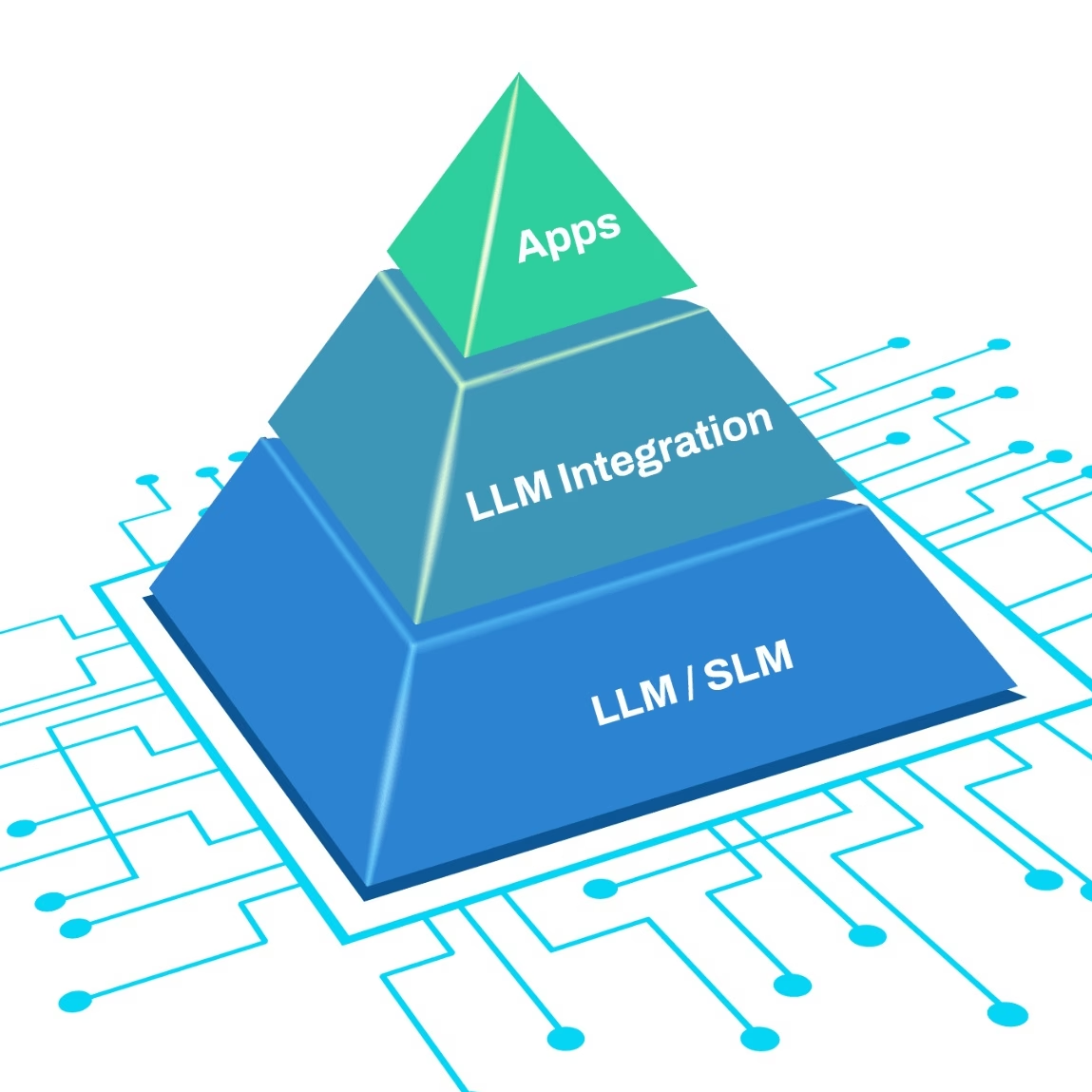
Hub of advanced AI technologies for modern conversational AI.
Utilizing Gen AI and Natural Language Processing (NLP) capabilities, the House of AI transforms customer conversations into engaging, human-like experiences. It goes deep into understanding context, sentiment, and intent, enabling dynamic, personalized responses that boost engagement and loyalty.

Enabling conversations with documents and knowledge bases to enhance productivity.
At Exotel, we understand the frustration of support engineers, service managers, IT personnel, sales representatives and customers when placed on hold. ExoInsights provides users with just the right and relevant answer, tailored to their specific queries. It simplifies access to accurate information, making the decision-making process more efficient and user-friendly.

AI-powered Conversation Quality Analysis tool
Automate cross-channel conversation quality analysis against your SOPs and KPIs to maintain top-tier service quality and agent efficiency, effortlessly.