
Every regulated contact centre audits its calls, and almost none audit more than three or four percent of them. That was never because a sample was enough. It was because scoring a call meant a person sitting and listening to it end to end, and at five hundred seats that is arithmetic, not policy. So quality assurance became a line item: sample, score, file, and defend the number when the auditor asks.
That described the constraint, not the value. When you can read every conversation instead of a sample, quality assurance stops being a cost you justify and becomes the most direct evidence you have of how your business actually runs. Going from four percent to a hundred was the first step, and what we didn’t expect was how quickly customers stop asking CQA quality questions and start asking it business questions.
One of our customers runs a five-hundred-seat contact centre with a carefully written SOP for every process. One of those SOPs said that whenever a customer asked about renewal pricing, the support agent should raise a ticket for sales to follow up on. When CQA read the actual conversations, it turned out that by the time sales called back the moment had passed, and the customer often did not pick up at all. So they changed the SOP: support now shares the pricing on that same call and still raises the ticket. Their renewals went up by twenty percent. The SOP had been written in a room, and it took reading every call to find out what was really happening on them.
This is a product we think belongs at Exotel rather than beside it. The conversations already run on our network, so there is nothing to export, no integration to build and no second system of record to reconcile. Analysis becomes something you switch on rather than a project you staff. What we bring on top of that is the years we have spent inside enterprise contact centres, which is most of why we know what is worth asking of a call at all.
Most of our recent work has gone into two problems. The first is getting the right questions to the right call. The second is turning what comes back into something a business can act on. Both are now live, and in both cases the judgement is the model’s rather than a rule someone has to maintain.
Smart Assignment: the call decides what gets checked
The naive version of this product is to send every call to an LLM with every question attached. It doesn’t work, because the answers themselves get worse. A large share of calls in any contact centre are voicemails, wrong numbers, customers who were never reached, eight-second hangups. Ask sixty KPI questions about a conversation that never happened and you don’t get sixty blank answers. You get confident findings about nothing, and a supervisor who spends the day reviewing noise instead of coaching anyone. Knowing what to send is the actual work, and it took us several attempts to get right.
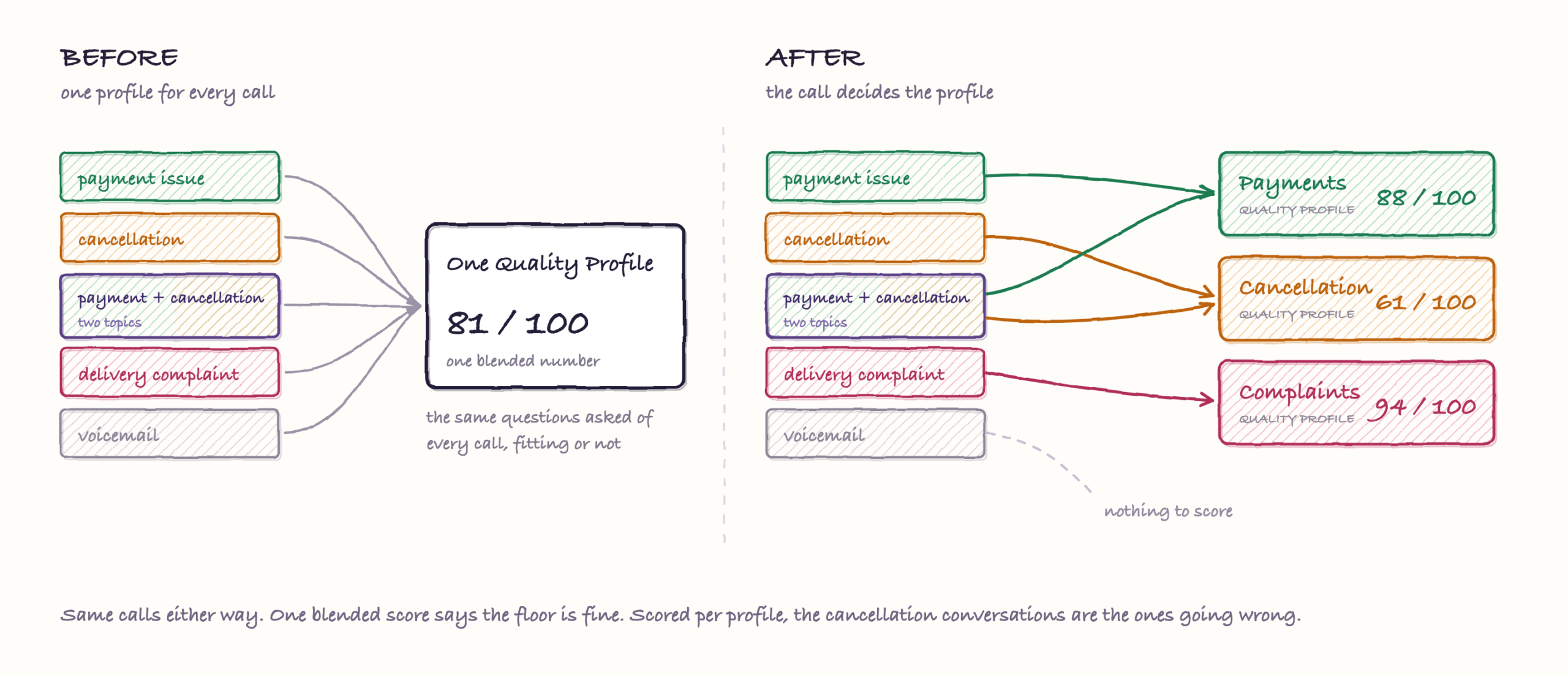
A Quality Profile is the set of KPIs you run on a call. Until now, calls reached one through rules you wrote on interaction metadata: campaign, queue, duration, time of day. Those rules work as long as each queue handles one kind of conversation. At enterprise scale, it never does. The same support line takes a refund request, a cancellation and a complaint within the same hour, and to a metadata rule all three look identical: same queue, same campaign, same shape. Only the conversation tells them apart.
Smart Assignment reads the conversation and assigns the Quality Profile from what was said. A call covering two topics, a payment problem that turns into a cancellation, is checked against both, and every applied profile is visible on the Interaction page. If nothing matches, a fallback profile still covers the call. And because the model will sometimes be wrong, the confidence threshold belongs to you: raise it if too many profiles are being applied, lower it if you want more considered.
AI Insights: information is not knowledge
The same chart every morning with a slightly different number on it is information. It was an insight the first time you saw it.
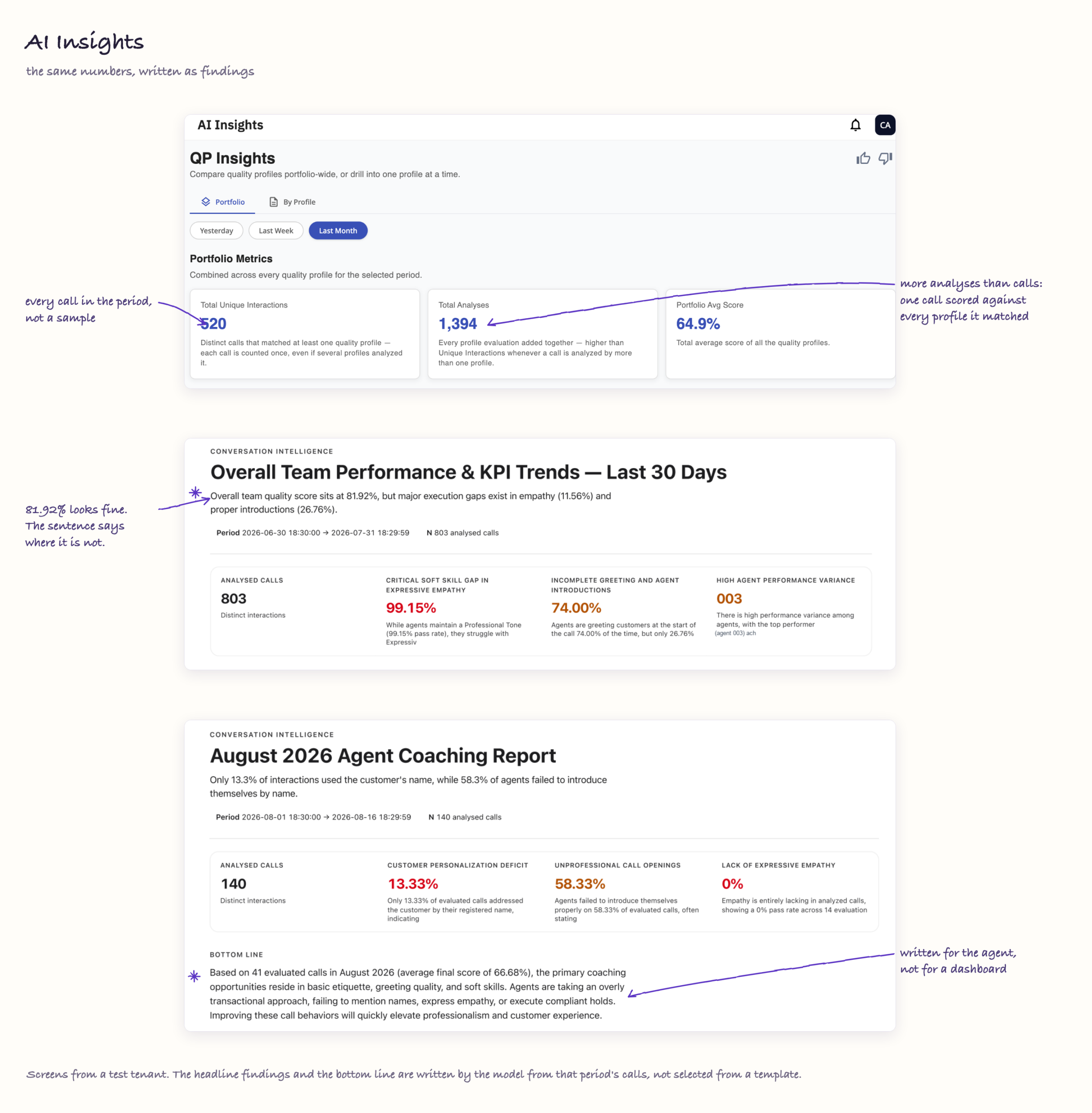
AI Insights starts from your business objectives instead of from a chart. It reads what happened across your calls over a period and surfaces what moved, where it’s breaking, and what deserves your attention this week. It changes as the business changes, which is the thing a fixed dashboard structurally cannot do.
Measurement on its own doesn’t change a call, so the same insight goes back to the agent as coaching meant for them: not that their score fell, but what they did on which calls and what to do differently. Same people, working with far better information than four percent of their calls could ever have given them.
Some of what customers do with this, we did not plan for. One of them uses it for fraud detection: a customer confirms a delivery on a recorded call, and the third party responsible for fulfilling it later claims the request was never made. That used to come down to one person’s word against another’s, and now the conversation itself is the record.
The bigger shift is the one we are building towards now. Quality was the wedge, because quality was mandated and budgeted for. But a system that can read every conversation for compliance can answer a far more valuable question: what are our customers actually telling us? What they ask for, what confuses them, what they complain about before they leave. That is the voice of your customer, in whatever language they choose to speak it, and no QA budget was ever sized for it.
If you run a contact centre at scale, the fairest way to judge this is on your own calls rather than on a demo. The infrastructure is already under your traffic, which is why a POC takes two weeks and not a quarter.